
Probate in California for Spanish Speaking Families — A Plain-Language Overview en Español
California has roughly 10.5 million Spanish speakers — more than any other US state — and Hispanic California residents make up about ~39% of the population per US Census data. When a family member dies, the probate process and probate administration should be accessible in Spanish. Often it isn't, because too few families know the resources exist or how to locate a spanish speaking probate lawyer for free information about their options.
Here's the short answer: most California estates worth less than `$184,500` don't need a probate attorney in California at all. The state's small-estate affidavit under Probate Code §13100 lets a surviving spouse, child, or other heir collect bank accounts, vehicles, and personal property by filing a 1-page sworn affidavit — no court hearing, no probate lawyer, no statutory fee under §10800.
Larger estates do require formal probate — sucesión — and that's where Spanish-language access matters most. The California courts publish every key form in Spanish through the Centro de Ayuda portal, and every superior court is required to provide free Spanish interpreters in civil hearings.
The Small-Estate Affidavit Under Probate Code §13100 — Probate Without an Attorney
California's small-estate affidavit is the single most useful tool for Latino families navigating a death in California. The threshold — $184,500 as of 2024, indexed for inflation under Probate Code §13101. Real property worth up to $61,500 can transfer through a related affidavit procedure.
How it works in practice. The heir waits 40 days after the death. They fill out the affidavit (available in Spanish through Centro de Ayuda), attach a certified death certificate, and present it to whoever holds the asset — the bank, the DMV, the credit union, the employer's HR department for a final paycheck. The holder is required by §13105 to release the asset to the affiant without court order.
No probate attorney. No probate court. No filing fee. The whole process can be completed in 2–4 weeks once the 40-day waiting period ends. For a family living paycheck to paycheck, that's the difference between losing access to a parent's checking account for 12 months of probate versus 2 weeks of paperwork.
Court Language Access Under Government Code §68563 — Free Spanish Interpreters for Every Probate Lawyer Hearing
California courts are required by Government Code §68563 to adopt and publish a Language Access Plan (LAP). The statewide Language Access Plan extends free certified interpreter services to all civil proceedings — including probate hearings, family law, eviction, small claims — not just criminal cases.
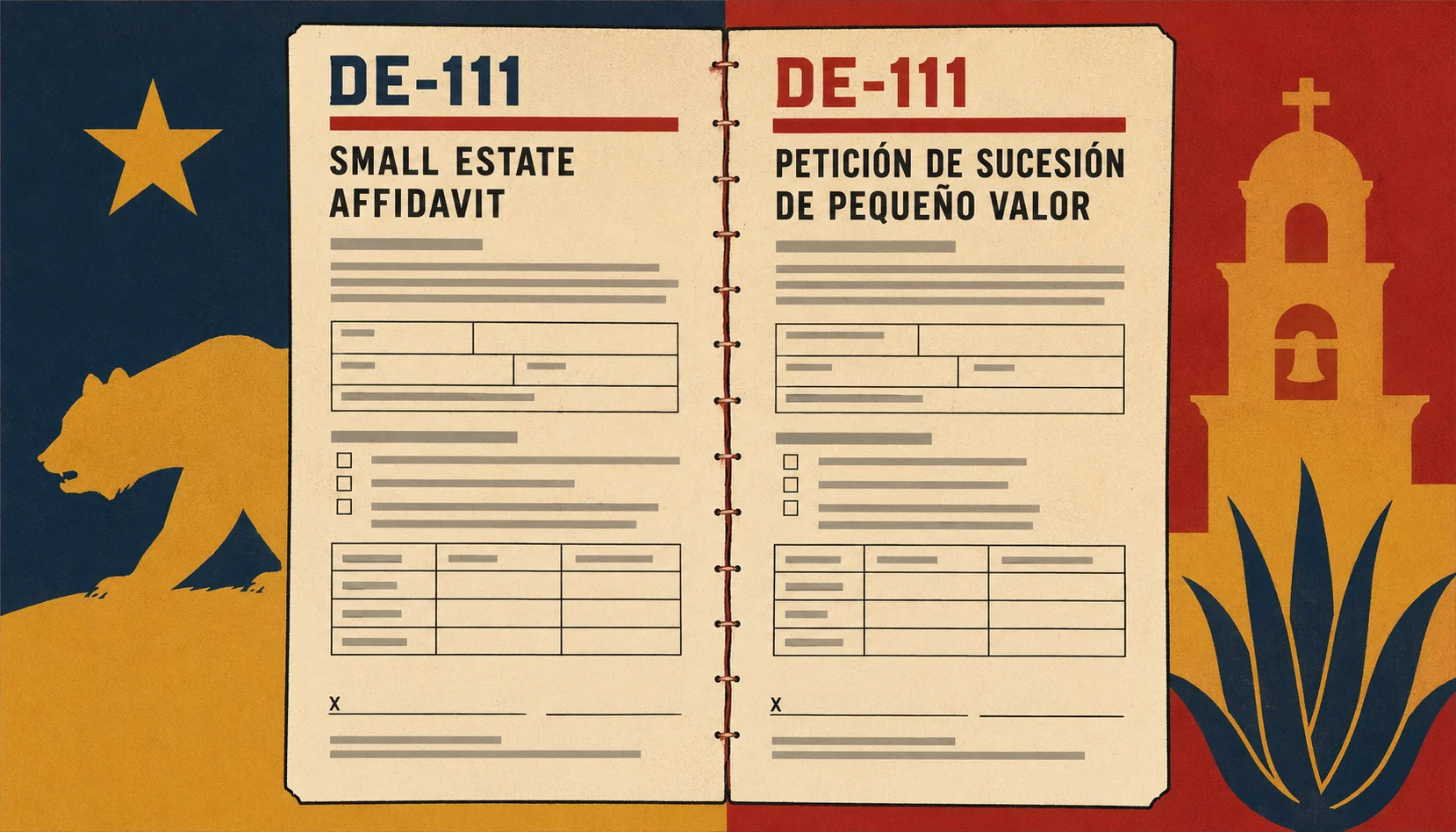
What that means at a probate hearing: if you're the petitioner on a DE-111 Petición de sucesión and you speak more comfortably in Spanish, you can request a court interpreter when you file. The interpreter is free. Spanish is by far the most-requested language, and every California superior court has Spanish-speaking interpreters on staff or on call.
Interpreter standards are set by Cal. Rules of Court 2.890 — only court-certified or court-registered interpreters can provide the service in proceedings. Don't let a friend or family member translate; that creates problems with the record and can lead to mistakes in sworn testimony.
Spanish Speaking Centro de Ayuda — Free Court Forms en Español
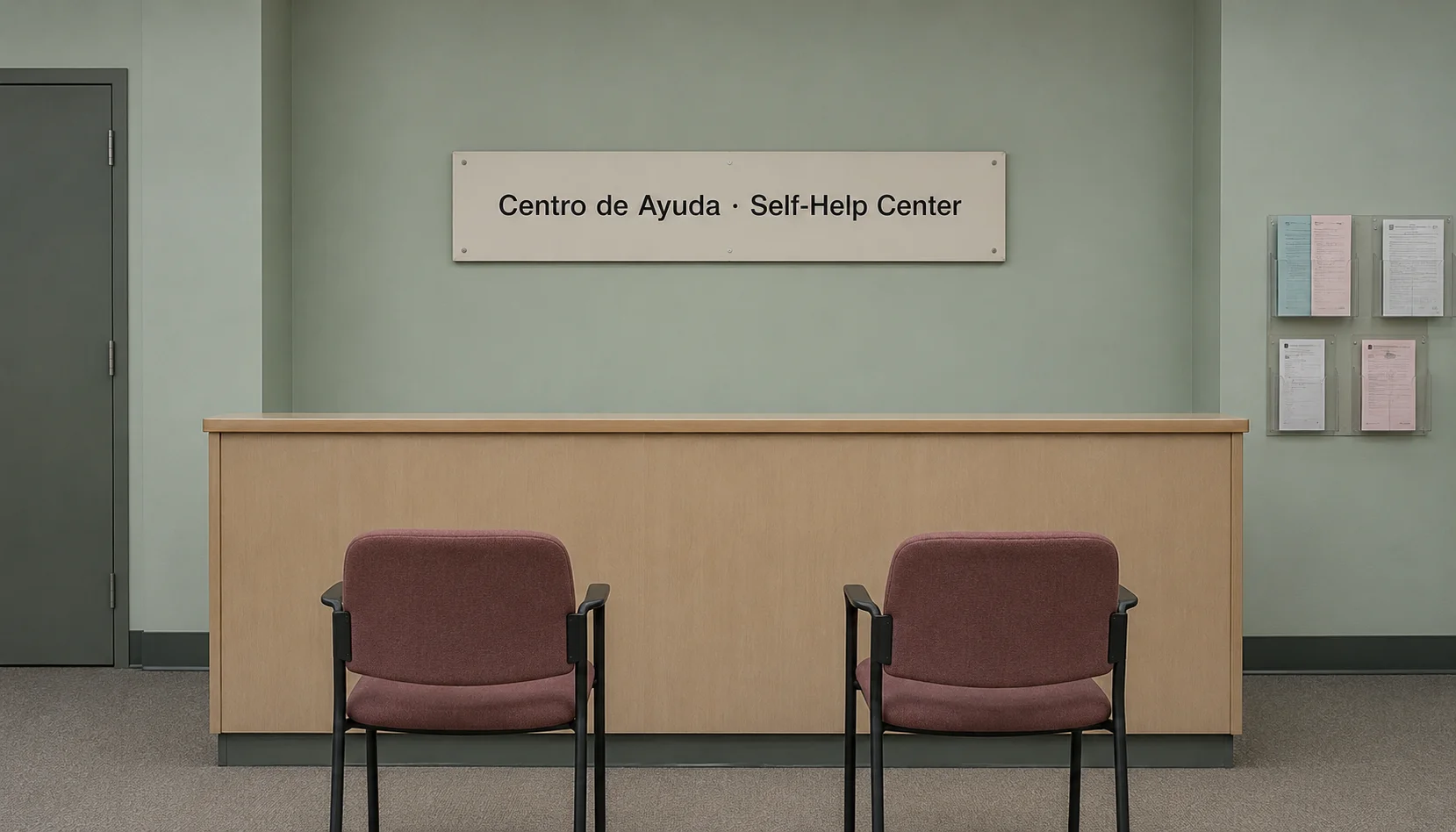
The California courts maintain Centro de Ayuda — the Spanish (español) version of the Self-Help Center. It covers probate (sucesiones), family law, eviction, civil harassment, conservatorships, and small claims. The probate-specific Spanish forms include the Petición de sucesión (DE-111), the Inventario y avalúo (DE-160), and step-by-step guides to the proceso de sucesión and bienes pequeños (small estates).
Forms in Spanish don't mean you file in Spanish — California court records are kept in English, so the actual filing translates back to the English version of the form. The Spanish translation is for the family to understand what they're signing. Same form, same legal effect, two languages on the same page.
Spanish Speaking County Self-Help Centers — Legal Services at the Courthouse
Every California superior court runs a Self-Help Center under Family Code §10005 — most have Spanish-speaking staff. The big counties:
Los Angeles County — the LA Superior Court Self-Help Center has Spanish-speaking staff at every walk-in location. LA processes the highest volume of small-estate affidavits in the state. San Francisco County — the SF Superior Court ACCESS Center provides Spanish, Mandarin, and Cantonese self-help support. Orange County — the OC Superior Court Self-Help Center sees heavy bilingual volume out of Santa Ana. San Diego County — the SD Superior Court Family Law Facilitator handles probate self-help with Spanish staff.
Smaller counties have fewer hours but every superior court must provide some level of self-help support per Family Code §10005. Call ahead to confirm Spanish availability on the day you plan to visit.
Common Pitfalls for First-Generation Immigrant Families — When You Need a Spanish Speaking Attorney
Three pitfalls show up over and over. First — out-of-country heirs. If a parent dies in California and an heir lives in Mexico, El Salvador, Guatemala, or anywhere outside the US, the probate court can still serve notice — but you'll need to gather addresses, possibly use the Hague Service Convention process, and account for translation and authentication of documents. Foreign documents typically need an apostille from the Department of State.
Second — foreign assets. California probate only reaches California-situs property. A bank account in Mexico City requires Mexican succession proceedings (sucesión testamentaria or intestamentaria), which run on a separate timeline with separate paperwork. A Spanish-speaking probate attorney in California with cross-border experience is worth the consultation cost here.
Third — intestate succession when documents are abroad. If a parent died without a will and key documents (marriage certificates, birth certificates, identification) are in the country of origin, Probate Code §6400–6402 still governs who inherits — but proving the family relationships requires apostilled foreign records. Plan extra time.
What Formal Probate Actually Costs in California — Why a Spanish Speaking Probate Attorney Becomes Worth It
When the estate exceeds the $184,500 small-estate threshold, formal probate kicks in — and California's statutory attorney fee schedule under Probate Code §10800 is one of the most expensive in the country. The schedule: 4% of the first $100K, 3% of the next $100K, 2% of the next $800K. On a $500K estate, that's $11,500 to the executor plus another $11,500 to the attorney — $23,000 in fees on top of court costs and the inventory appraisal under Probate Code §8800.
Our California probate calculator walks the math for your specific estate value. Spanish-speaking families pay the same statutory fees as everyone else — there's no cultural discount, no nonprofit alternative for formal probate. That's why the small-estate path matters so much: it avoids the §10800 schedule entirely when the estate qualifies.
Find a Spanish Speaking Probate Lawyer or Estate Planning Attorney in California
For estates that exceed the small-estate threshold, families often want a probate attorney or estate planning attorney who can speak Spanish (español/espanol) — probate lawyers abogados de sucesión y planificación patrimonial. Looking for an abogada or abogado as a law-firm partner who handles probate? Hispanic lawyers and Latina/o law firms practice probate across every major California county, with the heaviest concentrations in Los Angeles, Orange County, the Inland Empire, the Central Valley, and the Bay Area. The State Bar of California's Find a Lawyer tool lets you filter by language and practice area; the Hispanic National Bar Association maintains a directory of Spanish-speaking attorneys nationwide. Foreign assets and cross-border heirs can complicate the case — that's where an experienced bilingual probate attorney pays off.
For an estate planning attorney specifically — for trust administration, revocable living trusts, or pour-over wills — the same directories work. A trust administration matter (when a decedent had a living trust) avoids formal probate entirely; the successor trustee distributes assets per the trust terms. Many Spanish-speaking families set up a revocable trust during life specifically to spare the next generation the §10800 statutory fee. The Los Angeles County Bar Association (LACBA Lawyer Referral) runs a Spanish-language intake line for probate lawyers and abogados across LA County, and most county bar associations offer the same in their major counties.
What to expect at the consultation. A probate attorney will typically charge a flat fee or work under the statutory schedule; an estate planning attorney usually charges flat fees for trust packages ($2,500–$6,000 for a basic revocable trust + will + power of attorney). Confidential attorney-client communication and representation begin at the consultation. Bring death certificates, asset lists, and a list of family members. If trust administration or contested probate is involved, the practice areas of the law firms you contact should explicitly list probate litigation, not just estate planning. A good adviser will help you locate every asset, understand the legal services available, and decide which path is the most professional fit for the family's wealth and complications.
Pro Bono and Sliding-Scale Legal Aid — Free Attorney-Client Help for Latina/o Families
When the estate exceeds the small-estate threshold but the family can't afford a probate attorney in California, several nonprofits provide pro bono or sliding-scale probate help with Spanish-speaking staff.
California Rural Legal Assistance (CRLA) serves agricultural and rural Latino communities across the Central Valley and Inland Empire. Bay Area Legal Aid covers the nine-county Bay Area with Spanish staff at every office. Legal Aid Foundation of Los Angeles (LAFLA) handles LA County probate intake. OneJustice runs Justice Bus probate clinics that travel to underserved counties.
These organizations don't handle every estate — they have eligibility caps based on income and asset thresholds. But for families navigating a $200K–$400K estate with no liquid funds to pay attorney retainers up front, pro bono intake is the right starting call. CalMatters has covered the legal aid gap in California extensively — funding is tight, intake calendars fill quickly, but the services are real.
Quick Reference — Which Spanish Speaking Probate Attorney or DIY Path Fits Your Estate
Estate under `$184,500` — file the small-estate affidavit (Spanish version through Centro de Ayuda). No attorney needed. 2–4 weeks after the 40-day waiting period. Free.
Estate `$184,500–$500,000` — formal probate required. Consider sliding-scale legal aid through CRLA, Bay Area Legal Aid, or LAFLA. If you hire privately, budget $10K–$25K in attorney + executor statutory fees. Use the California probate calculator for an estimate.
Estate over `$500,000` — formal probate; sliding-scale legal aid likely won't qualify on assets. Hire a probate attorney in California with Spanish-speaking staff. Statutory fees under §10800 will run $25K+. A revocable trust during life would have avoided this entirely — relevant for the next generation's estate planning.
More on debt issues in our what happens to debts when you die guide — covers creditor claims that come up during California probate.

Disclaimer
Made For Law is not a law firm and does not provide legal advice. We're an editorial team and software provider, not affiliated with the California courts or any government entity. This article describes general California probate practice and Spanish-language court access as of 2026; statutes and court rules change. Consult a licensed California probate attorney or contact your county Self-Help Center for guidance specific to your situation.
Disclaimer: This article is for general educational purposes only and does not constitute legal advice. Made For Law is not a law firm, and our team are not attorneys. We are not affiliated with any federal, state, county, or local government agency or court system. Content may be researched or drafted with AI assistance and is reviewed by our editorial team before publication. Laws change frequently — always verify information with official sources and consult a licensed attorney for advice specific to your situation. Full disclaimer
- US Census datadata.census.gov
- Probate Code §13100leginfo.legislature.ca.gov
- Centro de Ayuda portalselfhelp.courts.ca.gov
- Probate Code §13101leginfo.legislature.ca.gov
- Government Code §68563leginfo.legislature.ca.gov
- statewide Language Access Plancourts.ca.gov
- DE-111 Petición de sucesiónselfhelp.courts.ca.gov
- Cal. Rules of Court 2.890courts.ca.gov
- Inventario y avalúo (DE-160)courts.ca.gov
- proceso de sucesiónselfhelp.courts.ca.gov
- bienes pequeños (small estates)selfhelp.courts.ca.gov
- Family Code §10005leginfo.legislature.ca.gov
- LA Superior Court Self-Help Centerlacourt.org
- SF Superior Court ACCESS Centersfsuperiorcourt.org
- OC Superior Court Self-Help Centeroccourts.org
- SD Superior Court Family Law Facilitatorsdcourt.ca.gov
- apostille from the Department of Statetravel.state.gov
- Probate Code §6400–6402leginfo.legislature.ca.gov
- Probate Code §10800leginfo.legislature.ca.gov
- Probate Code §8800leginfo.legislature.ca.gov
- State Bar of California's Find a Lawyer toolcalbar.ca.gov
- Hispanic National Bar Associationhnba.com
- LACBA Lawyer Referralsmartlaw.org
- California Rural Legal Assistance (CRLA)crla.org
- Bay Area Legal Aidbaylegal.org
- Legal Aid Foundation of Los Angeles (LAFLA)lafla.org
- OneJusticeonejustice.org
- legal aid gap in Californiacalmatters.org

Our editorial team researches and summarizes publicly available legal information. We are not attorneys and do not provide legal advice. Every article is checked against current state statutes and official sources, but you should always consult a licensed attorney for guidance specific to your situation.