

The AI legal marketing landscape, honestly assessed
Walk through any legal tech conference in 2026 and half the exhibitor booths say "AI for law firms." Most of those products are GPT-4 with a logo and a $300/month price tag. A few are genuinely useful. Telling the difference is the whole game.
This guide separates the categories that work from the ones that don't, and gives you a framework for evaluating new AI tools before you spend a dollar. The short version: AI is good at first drafts, pattern recognition, and summarization. AI is bad at legal judgment, client trust signals, and unsupervised content publishing.
Every recommendation below assumes attorney review of AI output. That's not optional — it's a bar ethics requirement in every US jurisdiction and an SEO requirement under Google's helpful content classifier.
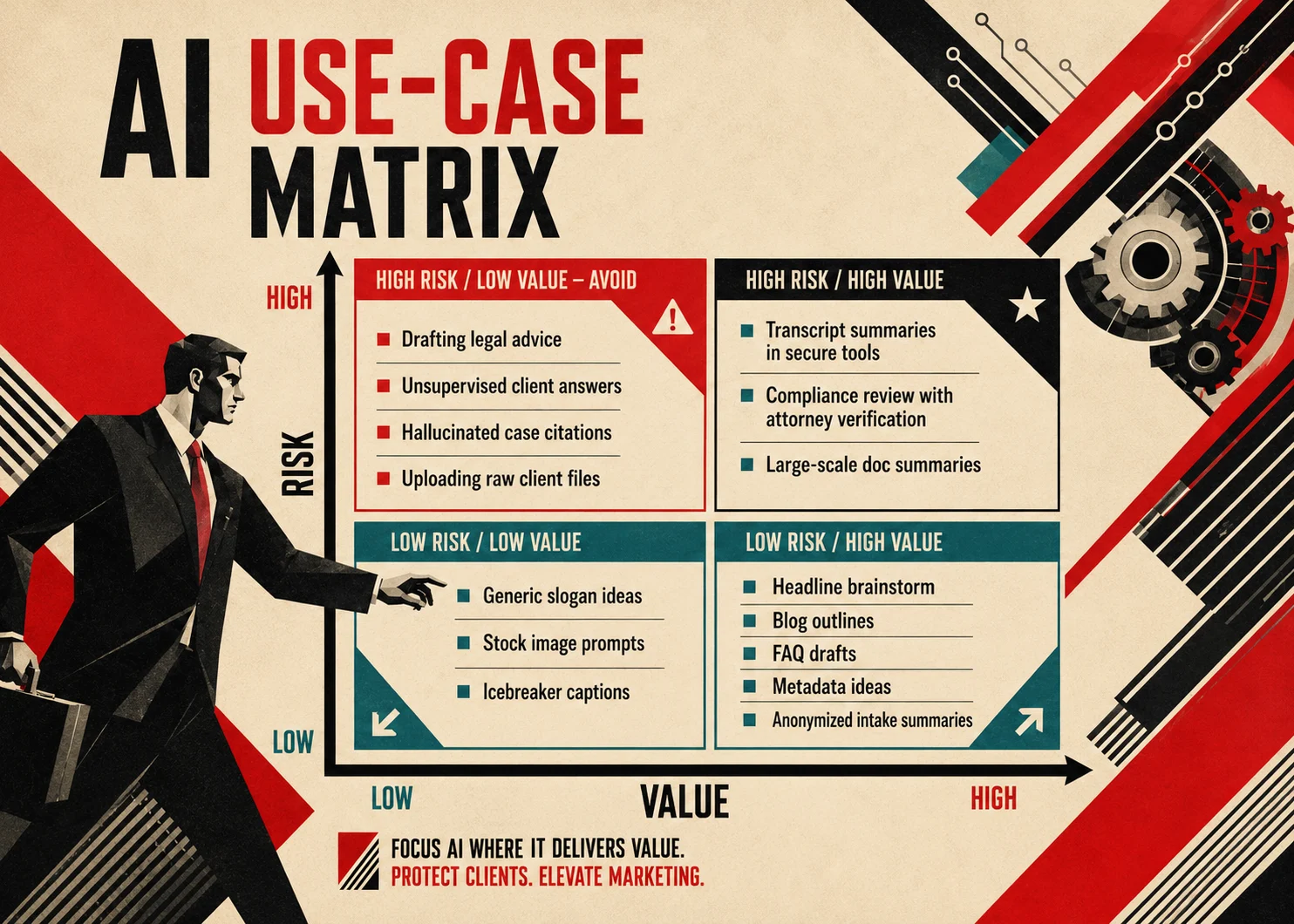
What AI is genuinely useful for in legal marketing
Five use cases where AI delivers real ROI today:
1. Content outlines and research. ChatGPT, Claude, or Perplexity can pull together a 1,500-word outline for "How probate works in Ohio" in 5 minutes with statute references that the attorney then verifies and expands. Saves 2–3 hours of pre-writing research per article.
2. Ad copy variants. Need 10 variants of a Facebook ad headline for split testing? AI generates them in 30 seconds. Attorney picks the 3 best, runs them, scales the winner.
3. Intake call summarization. Tools like Otter, Fireflies, or built-in features in Clio Manage transcribe and summarize intake calls. Attorney reviews the summary, saves 15–20 minutes per consult.
4. GBP post drafting. AI generates first drafts of GBP posts based on a topic — "Ohio raised the small-estate threshold to $35K," AI drafts a 100-word post, attorney edits and publishes in 5 minutes.
5. Analytics surfacing. GA4's built-in AI insights, Google Search Console's "top queries" automation, and CRM lead-scoring features point you at what to look at next. Not decision-making — surfacing.
Common thread: AI accelerates the early-stage work. The attorney's expertise — and the bar-required review step — turn AI drafts into deliverable output.
Where AI is a liability, not an asset
Three categories where AI is actively damaging:
1. Unedited blog content. Google's helpful content guidance (a series of algorithm updates from 2022 through 2026) specifically targets scaled AI-generated content with no firsthand expertise. AI blog posts published unreviewed are demoted and they drag down domain authority signals for the rest of the site. Worse than no blog posts.
2. AI-generated client communication. Auto-drafted client emails, AI chatbots that respond to client questions without attorney oversight — these are bar ethics minefields. Unauthorized practice of law issues arise the moment an AI tool answers a legal question for a client without attorney supervision.
3. AI legal research without verification. Hallucinated case citations are a documented and ongoing problem. Multiple attorneys have been sanctioned (and disbarred in extreme cases) for citing AI-fabricated case law in court filings. Same risk applies to marketing content with fabricated statute references.
The framing for every AI use: if the output reaches a client, a court, or a search engine without attorney verification, it's a liability. Verification is the firewall.
The right AI tool stack for solo and small firms
Three subscriptions cover 90% of legal AI marketing needs:
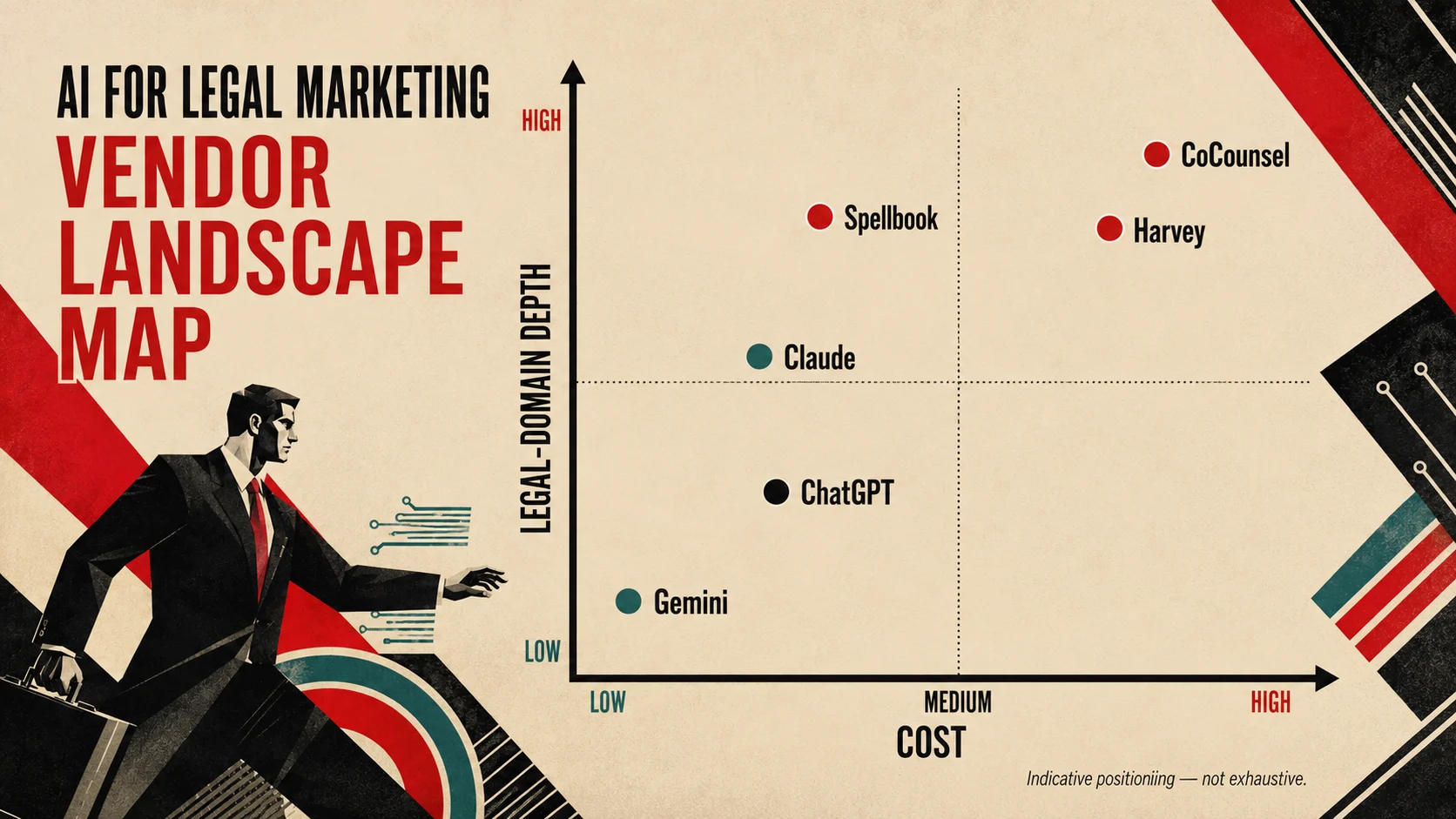
1. ChatGPT Plus or Claude Pro (`$20–`$25/mo`). General-purpose AI for content outlines, ad copy, email drafts, summarization. Skip the GPT-4 wrappers selling themselves as "legal AI" — they're almost all charging 10–20x for the same model with a thin UI.
2. Otter or Fireflies (`$15–`$30/mo`). Audio transcription and summarization for intake calls and depositions (the marketing-relevant use is intake summarization).
3. Built-in AI features in your existing tools. GA4 insights, Search Console anomaly detection, Clio Duo / MyCase AI, Lawmatics intelligence — these are usually included in your existing subscriptions. Use them.
What to skip: standalone "AI marketing platforms for lawyers" that wrap GPT-4 with a legal-themed UI and charge $200–$500/mo`. Almost none of them deliver capabilities ChatGPT Plus doesn't already provide. The exceptions are rare and usually involve deep practice-management integration (Clio Duo is the strongest example — bundled with Clio Suite, not a separate tool).
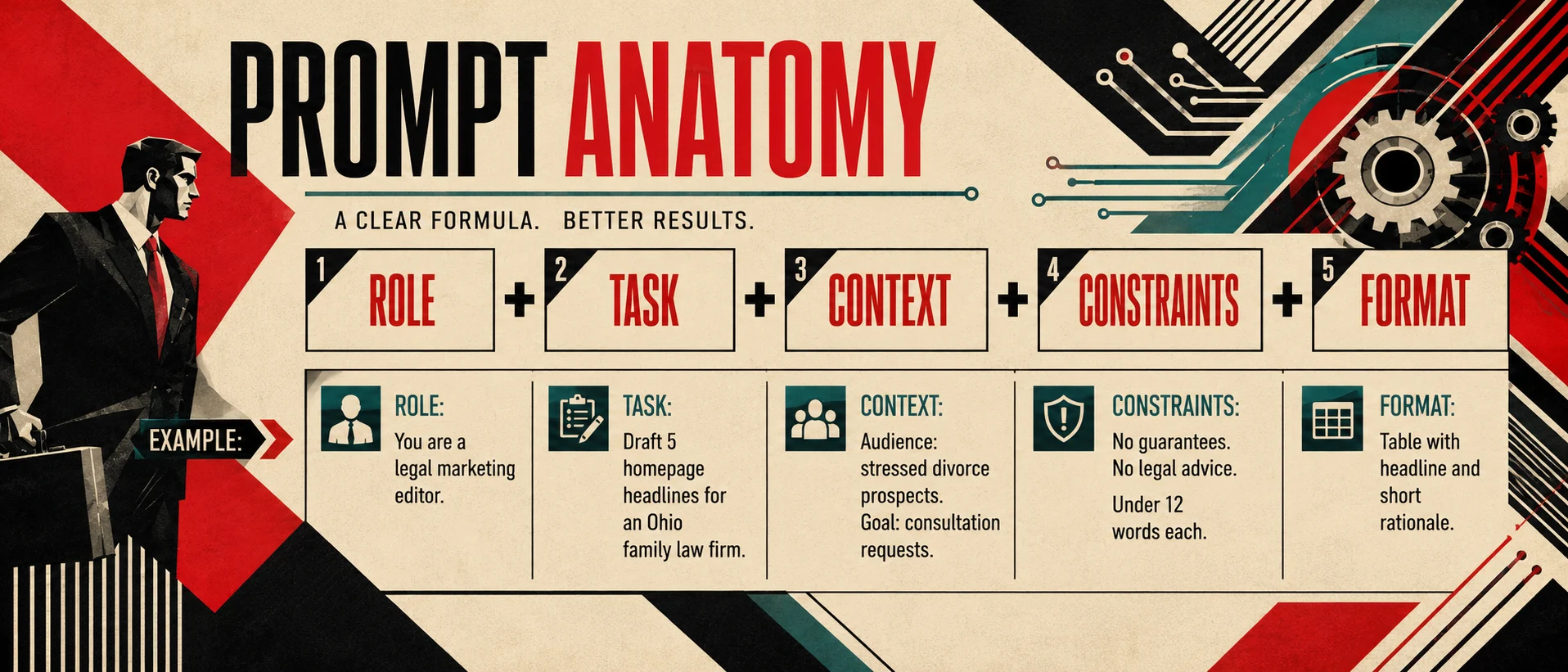
Prompting that actually delivers good output
AI output quality is mostly a function of prompt quality. Five rules:
- Specify the audience. "Write for a small-firm probate attorney audience," not "write a blog post." The model behaves differently for different audiences.
- Specify constraints. Word count, tone, structure, sources to cite. "1,500 words, conversational tone, cite real Ohio statutes by code section, include a calculator CTA in the conclusion."
- Provide source material. Paste in your existing best blog post and say "match this voice." Paste in the relevant statute and say "use this language." Models without source context hallucinate.
- Ask for outlines first, drafts second. The 2-step process beats single-shot generation. Outline → review → expand.
- Verify every statute citation, case reference, and statistic. AI hallucinates citations confidently. Treat every cite as suspect until verified.
AI and Google's helpful content classifier
Google's stance on AI content has evolved across 2022–2026 updates. The current position: AI content is fine if it's helpful, expert-authored, and not scaled-pattern. Scaled AI content with no editorial expertise gets demoted.
What that means in practice:
- Don't publish AI drafts unreviewed. Have the attorney expand, verify, and add firsthand expertise.
- Don't run AI content templates across 50 location pages with `${city}` swaps. That pattern triggers the scaled-content classifier and demotes the whole domain.
- Do disclose AI assistance where it's material — many firms add "AI-assisted research" notes to articles for transparency, which both satisfies ethical disclosure and signals editorial honesty to readers.
Google rewards content where the AI assistance is invisible because the attorney's expertise dominates the output. Content where AI is visible (generic phrasing, no real-world specificity, hallucinated cites) gets punished. The line is who's actually contributing the expertise.
AI for ad creative — the legitimate sweet spot
If there's one marketing function where AI delivers undeniable ROI at solo scale, it's paid-ad creative iteration. Three workflows:
- Ad headline split testing. Generate 20 headline variants in one ChatGPT prompt. Run the top 5. Scale the winner. Iterate weekly. Cuts the time-to-best-headline from weeks to days.
- Ad image variant generation via Midjourney or DALL-E. Generate 8 image options for a campaign, pick the 2 best, test against each other. (For attorney sites: skip AI-generated headshots — they look uncanny and tank trust signals. AI for background imagery is fine.)
- Ad video script drafts. AI drafts 30-second video scripts in your voice. Attorney records the videos themselves (don't use AI avatars — clients hate them in legal contexts).
Ad creative is a high-leverage AI sweet spot because the work is iterative, the cost of testing is low, and the attorney still controls publication.

Bar ethics — what you have to disclose
Bar ethics rules on AI in legal marketing are evolving fast and vary by state. As of mid-2026, the floor is:
- Attorney supervision of AI output that touches client matters is required everywhere. No exceptions.
- Disclosure of AI use in marketing content is encouraged in some states (Florida, California, Texas) and not yet required. When in doubt, disclose.
- AI-generated content presented as the attorney's own work without disclosure raises ethical concerns under most state "misleading communication" rules.
Check your state bar's most recent guidance on AI before launching any AI-heavy marketing program. The rules are updating quarterly in some jurisdictions; stay current. See our companion guide on when attorneys must disclose AI use for the ABA Formal Opinion 512 framework and our AI compliance checklist for solo and small firms.
Practical 30-day AI implementation plan
If you have no AI marketing process today:
Week 1. Subscribe to ChatGPT Plus or Claude Pro. Run 5 test prompts on tasks you do regularly — content outline, ad headlines, intake-call summary. Learn the model's strengths and limits.
Week 2. Pick one workflow to AI-assist. Easiest: blog post outlines. Generate the outline with AI, expand it yourself, publish. Measure time saved.
Week 3. Add a second workflow: ad copy iteration. Generate 10 headline variants weekly for active ad campaigns. Test and track winners.
Week 4. Evaluate built-in AI in your existing tools (Clio Duo, GA4 Insights, etc.). Most firms have AI features they aren't using because nobody flipped the switch.
By day 30, AI assistance should save 3–8 hours a week on marketing tasks. Don't push for more than that — the diminishing returns hit fast, and the bar ethics risk of over-automation outweighs the time savings.
Disclaimer: This article is for general educational purposes only and does not constitute legal advice. Made For Law is not a law firm, and our team are not attorneys. We are not affiliated with any federal, state, county, or local government agency or court system. Content may be researched or drafted with AI assistance and is reviewed by our editorial team before publication. Laws change frequently — always verify information with official sources and consult a licensed attorney for advice specific to your situation. Full disclaimer
- Google's helpful content guidancedevelopers.google.com

Alex Tarlescu is co-founder of Made For Law — the SaaS platform that gives attorneys embeddable legal calculators with built-in lead capture. He's also co-founder of Good Smart Idea, the sister marketing agency that handles broader marketing engagements for law firms. Based in Cleveland with nearly 20 years of experience in sales, digital marketing, and AI automation, he writes about marketing — not legal advice — and the systems that turn website visitors into signed clients.