Why a 1954 Treaty Still Runs Cross-Border Estates Today
The U.S.-Japan Estate Tax Treaty was signed in Washington on April 16, 1954 — 72 years ago — and amended once in 1965. It's still the only bilateral estate-tax instrument Japan has with any country — and it sits on the IRS's official treaty list alongside 16 others.
Here's the thing — most cross-border estate-planning content treats it like background noise. It isn't. The treaty controls three specific decisions that change the dollar amount an heir owes: which country has the right to tax a given asset (Article III), how each country credits tax paid to the other (Article IV), and how to break domicile ties when the decedent had homes in both (Article V).
If your grandmother died last week in Kanagawa Prefecture holding a Honolulu condo, a Tokyo apartment, and Toyota shares in a Nomura account — the treaty decides which government gets first crack at which asset. Not Japanese law alone. Not U.S. law alone. The treaty.
Article III — Situs (Where an Asset Is Located, Legally)
Article III assigns each category of property to a jurisdiction by situs — the technical-legal location of the asset, which isn't always the same as where the asset physically sits.
Real property follows physical location — the Honolulu condo is U.S.-situs, the Tokyo apartment is Japan-situs. That part's straightforward. Bank accounts follow the location of the bank branch holding the account, which means a Mizuho Bank Tokyo account is Japan-situs even if the heir lives in Los Angeles.
Stocks get weirder. A Toyota Motor Corporation share certificate held in a Nomura Securities account is Japan-situs under Article III(2)(c) — even though Toyota also trades as an ADR on the NYSE. The treaty controls the certificate's situs, not the company's listing.
Tangible personal property follows physical location at the moment of death. A Hokusai woodblock print stored in a vault in Kyoto is Japan-situs. Move the print to a New York gallery a week before death and it becomes U.S.-situs. Timing matters. Estate-planning attorneys know this. Heirs often don't.
Article IV — The Credit Mechanism (How Double Tax Gets Unwound)
Article IV is the practical heart of the treaty. When both countries claim the right to tax the same asset — usually because of domicile conflicts or worldwide-taxation rules — one country credits the tax paid to the other.
The mechanism isn't symmetric. The U.S. credits Japanese inheritance tax under IRC § 2014 (the foreign death tax credit) up to the U.S. tax attributable to the foreign-situs property. Japan credits U.S. federal estate tax under Article 20-2 of the Sōzokuzei-hō (Inheritance Tax Law) on a similar attributable-portion basis.
In plain English: the country with primary taxing rights (under Article III's situs rules) gets paid first, and the other country reduces its tax dollar-for-dollar by the amount paid to the first country — but only up to the share of its own tax that the doubly-taxed asset would have generated.
Honestly, the worst outcomes happen when families pay the wrong country first. If your executor files U.S. Form 706 and pays U.S. tax on a Tokyo apartment that's actually Japan-situs under Article III, Japan will tax it again and Article IV won't credit the U.S. payment fully — because the U.S. had no primary right to tax it.
Article V — Domicile Conflicts and the Tie-Breaker Rules
Article V matters when the decedent had homes in both countries — a retiree who split time between Hawaii and Yokosuka, for example, or a dual citizen who held green-card status the whole time.
Under U.S. tax law, a permanent resident (green card holder) is treated as domiciled in the U.S. for estate-tax purposes, which means the worldwide-estate rules apply. Under Japanese law, if the decedent had a jūsho (legal residence) in Japan at the time of death, the worldwide-estate rules apply there too. Both can be true. The treaty resolves the conflict.
Article V's tie-breaker test asks (in order) where the decedent had a permanent home available, where the center of vital interests was, where the habitual abode was, and finally — if all else is tied — what the citizenship was. The order matters because earlier criteria override later ones.
You might be wondering why this exists at all. The reason: without Article V, a dual-domicile decedent would have both the U.S. and Japan applying their full worldwide-estate regimes simultaneously, and the foreign-death-tax credit would only partially unwind the overlap. The tie-breaker forces one country into the secondary role.
What the Treaty Cannot Do
The treaty allocates and credits. It doesn't harmonize.
Japan's inheritance tax is paid by each heir on the heir's share, with rates from 10% (under ¥10 million share) to 55% (over ¥600 million share). The U.S. federal estate tax is paid by the estate, at a flat 40% marginal rate above the exemption. The treaty doesn't change either rate structure — it just decides who taxes what.
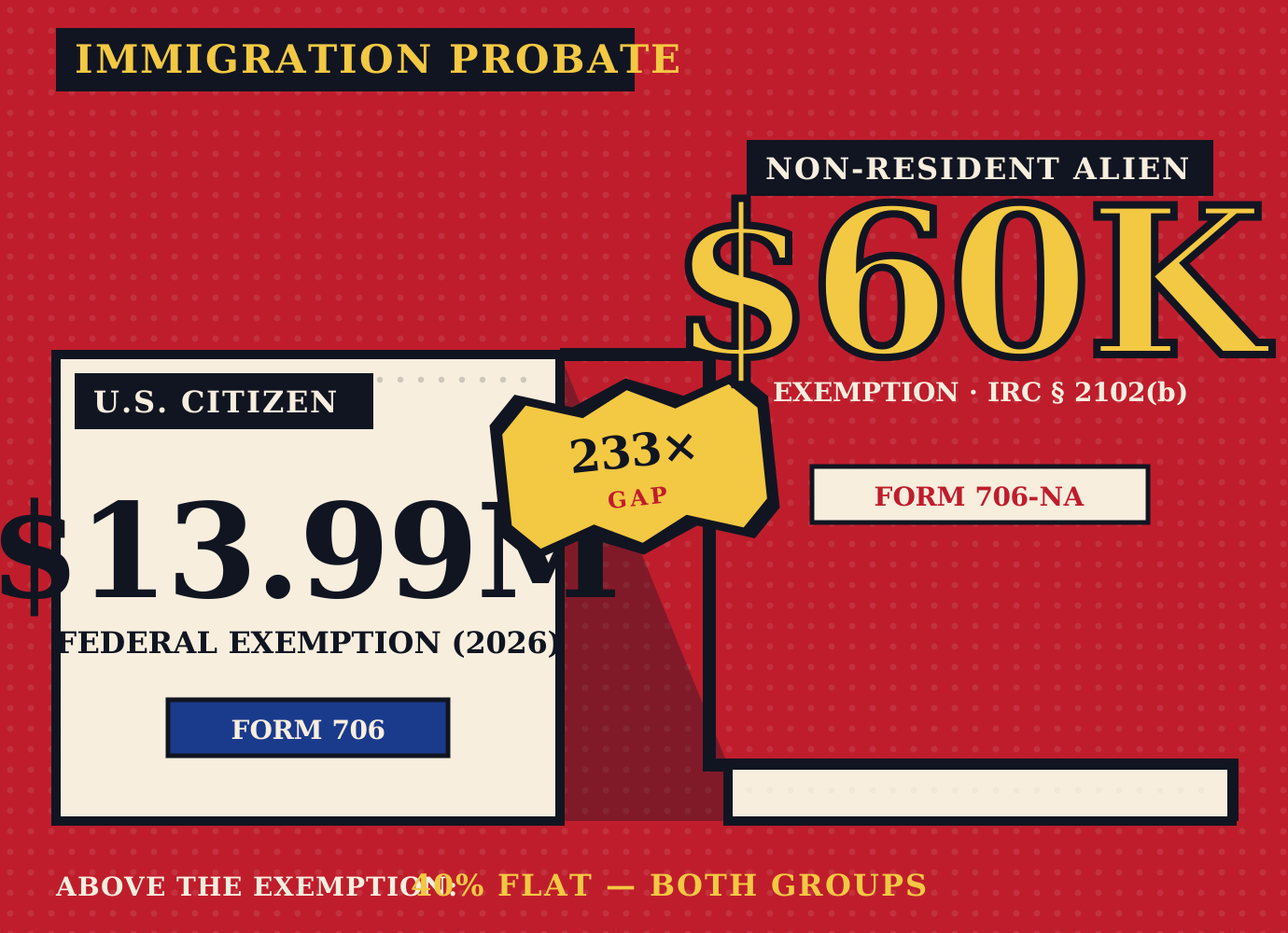
It also doesn't help with Japan's ¥30 million + ¥6 million per heir basic deduction or the U.S. exemption gap between citizens ($13.99M in 2026) and non-resident non-citizens ($60,000). Those are domestic-law features the treaty leaves intact. We cover the U.S. side of that gap in our Non-Resident Alien Estate Tax guide.
And it doesn't address Japan's forced-heirship system (iryūbun) — the legitimate-portion rules under Articles 1042-1043 of the Japanese Civil Code that guarantee spouses and children a minimum statutory share. U.S. trusts can run head-on into iryūbun when Japanese-situs assets are involved. That's a structural problem the treaty was never designed to fix.
Filing Deadlines That Actually Matter
U.S. federal estate tax Form 706 is due 9 months after death, with a 6-month automatic extension available on Form 4768. Japanese inheritance tax is due 10 months after death under Article 27 of the Sōzokuzei-hō, and the extension process there is much more limited.
The short answer is — file Japan first if Japan has primary taxing rights, and file the U.S. on its own track regardless. Don't wait for one filing to inform the other; the deadlines don't sync.
Late-filing penalties in Japan are particularly painful. Article 60-2 imposes delinquent-filing additional tax (mukōshin-kashū-zei) of 15% on the unpaid amount up to ¥500,000 and 20% above that, plus enshu-zei (delay interest) compounded annually at rates published by Japan's National Tax Agency. The U.S. failure-to-file penalty under IRC § 6651(a)(1) starts at 5% per month, capped at 25%. Different mechanics. Both expensive.
Practical Checklist for Cross-Border Estates
Pull a koseki tōhon (family-registration extract) for the decedent within the first 30 days. Japanese banks, securities firms, and the tax office will all ask for it. The decedent's last U.S. tax return — Form 1040 or 1040-NR — should also be on file, because the IRS uses it to identify worldwide-income reporters who may have worldwide-estate exposure.
Identify each asset's situs under Article III before deciding which return to file first. Real estate goes by physical location. Financial accounts go by branch. Stocks go by certificate registration. Tangibles go by physical location at death.
Engage local counsel in both jurisdictions early. A U.S. estate-planning attorney — running the numbers through tools like our federal estate tax calculator — coordinating with a Japanese zeirishi (licensed tax practitioner) and gyōseishoshi (administrative scrivener) is the standard team structure for an estate over $1 million with assets in both countries. The U.S. attorney handles Form 706 and the credit calculations; the zeirishi handles the Japanese inheritance tax return and the credit on the Japanese side.
Run the numbers on both sides before paying either. The wrong-country-first problem is the single most common error in cross-border probate, and it's nearly always preventable with a half-day coordination call between counsel.
Disclaimer: This article is for general educational purposes only and does not constitute legal advice. Made For Law is not a law firm, and our team are not attorneys. We are not affiliated with any federal, state, county, or local government agency or court system. Content may be researched or drafted with AI assistance and is reviewed by our editorial team before publication. Laws change frequently — always verify information with official sources and consult a licensed attorney for advice specific to your situation. Full disclaimer
- official treaty listhome.treasury.gov
- IRC § 2014law.cornell.edu
- Form 706irs.gov
- Form 4768irs.gov
- Japan's National Tax Agencynta.go.jp
- IRC § 6651(a)(1)law.cornell.edu

Our editorial team researches and summarizes publicly available legal information. We are not attorneys and do not provide legal advice. Every article is checked against current state statutes and official sources, but you should always consult a licensed attorney for guidance specific to your situation.