
The Cliff Nobody Mentions Until It's Too Late
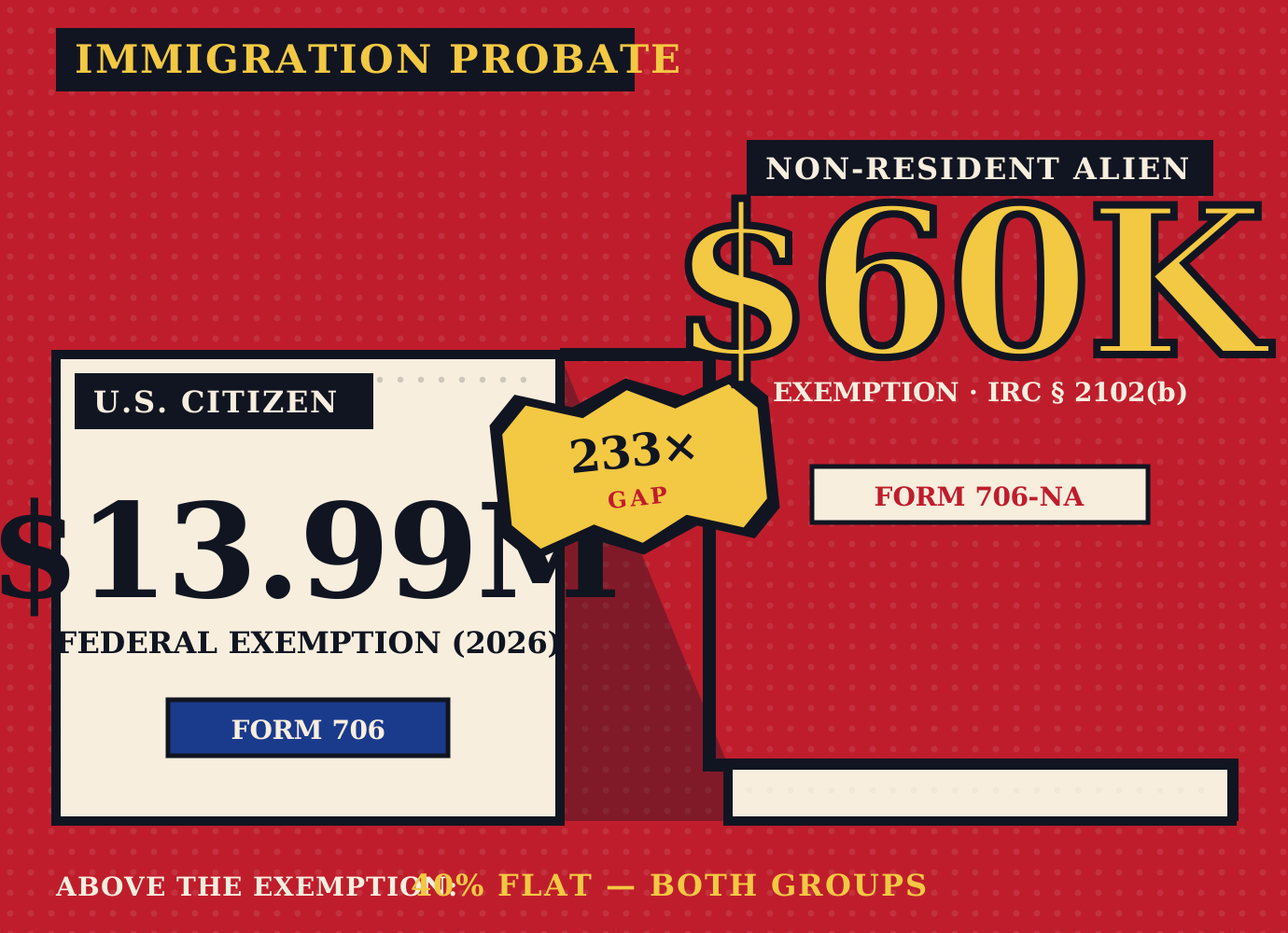
A U.S. citizen dying in 2026 with $5 million of U.S. assets pays zero federal estate tax — the $13.99M unified credit under IRC § 2010(c)(3) absorbs the entire taxable estate.
A foreign national on an E-2, O-1, H-1B, or L-1 visa dying the same year with the same $5 million of U.S. assets pays roughly `$1,976,000`. The math is simple: ($5,000,000 - $60,000) × 40% = $1,976,000. The $60,000 exemption comes from IRC § 2102(b), which sets a separate unified credit for non-resident non-citizens equal to the tax on a $60,000 taxable estate.
Here's the thing — most U.S. estate-planning material assumes the audience is a U.S. citizen or domiciliary. The non-resident-alien rules sit in IRC chapter 11 subchapter B (§§ 2101-2108), and they're a parallel regime, not a footnote. Every probate attorney who's handled an immigration case will tell you the same thing: the family had no idea until the closing letter from the IRS arrived.
Who Counts as a Non-Resident Non-Citizen for Estate-Tax Purposes
The IRS distinguishes non-resident aliens (NRAs) from resident aliens using a domicile test — not the 183-day substantial-presence test that applies to income tax. Two completely different definitions of "resident."
For estate-tax purposes under Treas. Reg. § 20.0-1(b), a decedent is a U.S. domiciliary if they were living in the United States with no definite present intention of later removing therefrom. A green-card holder is presumptively a U.S. domiciliary. A visa holder is presumptively not — the visa itself is evidence of an intent to depart eventually.
But intent is factual. A holder of an O-1 (extraordinary ability) visa who has lived in San Francisco for 12 years, bought a home, enrolled kids in California schools, and let their passport lapse might fail the non-domiciliary test. The IRS has won estate-tax domicile cases against people holding non-immigrant visas — Estate of Khan v. Commissioner (T.C. Memo 1998-22) is the classic example. Don't assume the visa controls.
If the decedent was a U.S. domiciliary, the worldwide-estate rules apply and the $13.99M exemption is available — regardless of citizenship. If the decedent was a non-resident non-citizen, only U.S.-situs assets are taxed, and only $60,000 is exempt.
What Counts as U.S.-Situs Property for an NRNC
U.S. real estate is always U.S.-situs. So is tangible personal property physically in the U.S. at the time of death — a car parked in a New York garage, jewelry in a Beverly Hills safe-deposit box.
Stock in a U.S. corporation is U.S.-situs under IRC § 2104(a), even if held in an overseas brokerage account. That's the trap most foreign investors hit. Honda ADRs bought through a Tokyo branch of a Japanese broker are not U.S.-situs (the issuer is Honda Motor Co., Ltd. — a Japanese corporation). But Tesla shares held in the same Tokyo account are U.S.-situs, because Tesla is a Delaware corporation.
Bank deposits are mostly not U.S.-situs. IRC § 2105(b) excludes deposits with U.S. banks, savings & loans, and credit unions from the NRNC's taxable estate — provided the deposit isn't effectively connected to a U.S. trade or business. That's the carve-out most foreign investors don't know exists.
Life-insurance proceeds on the life of a non-resident non-citizen are not U.S.-situs under IRC § 2105(a) — the IRS confirms this in its FAQ on estate taxes for nonresidents. A foreign national holding a U.S. life-insurance policy can leave the death benefit to U.S. heirs without it entering the U.S. estate tax base. That's a planning lever, not a loophole.
How Form 706-NA Actually Works
Form 706-NA, United States Estate (and Generation-Skipping Transfer) Tax Return — Estate of nonresident not a citizen of the United States, is the NRNC-specific estate-tax return. It's structurally similar to Form 706 but uses the $60,000 exemption and the $13,000 unified-credit equivalent under IRC § 2102(b).
Filing is required if the decedent's gross U.S.-situs estate exceeds $60,000 at death. That threshold is the actual statutory trigger — not the citizen exemption. An estate of $75,000 in U.S. real estate held by a foreign national requires filing Form 706-NA — run the numbers through our federal estate tax calculator before engaging counsel.
The return is due 9 months from the date of death under IRC § 6075(a). Form 4768 buys an automatic 6-month extension. Late-filing penalty starts at 5% per month under IRC § 6651(a)(1), capped at 25% of the unpaid tax.
In plain English: even modest U.S.-asset holdings by a foreign national can trigger a filing obligation that the family doesn't know exists until they try to transfer a U.S. brokerage account or sell a New York condo and the bank or title company asks for a federal transfer certificate.
Treaty Relief — Narrow, but Real
The U.S. has bilateral estate-tax treaties with 17 countries. The list: Australia, Austria, Canada, Denmark, Finland, France, Germany, Greece, Ireland, Italy, Japan, Netherlands, Norway, South Africa, Switzerland, the U.K., and Sweden.
If the decedent was domiciled in one of those countries, the treaty may provide a larger exemption than the $60,000 statutory floor. The exact mechanism varies. The U.S.-Japan treaty (covered separately in our Japan-U.S. inheritance treaty article) uses Articles III-V to allocate taxing rights. The U.S.-U.K. treaty uses a domicile tie-breaker. The U.S.-Canada treaty (technically a protocol to the income-tax treaty, not a standalone estate treaty) provides a prorated unified credit.
Critically — the treaty doesn't change the $60,000 statutory exemption directly. It either reallocates situs (so the asset isn't U.S.-situs at all) or it allows the foreign domiciliary to claim a prorated version of the citizen exemption based on the U.S.-situs share of the worldwide estate.
To be fair, the prorated unified credit is the planning tool that matters most. Under Treas. Reg. § 20.2102-1(c), a domiciliary of a treaty country who has a worldwide estate of $10 million with $2 million of U.S.-situs assets can claim ($2M / $10M) × $13.99M = $2.798M of unified credit — way above the statutory $60,000 floor.
Planning Levers Before Death
Hold U.S. real estate through a non-U.S. corporation. The corporation owns the property; the foreign national owns the corporation. At death, the asset transferred is corporate stock — and stock of a foreign corporation is not U.S.-situs even when the underlying property is. The IRS has fought this structure for decades but it remains effective under current law if the corporation is bona fide and not a sham.
Use a U.S. life insurance policy for U.S. heirs. As covered above, the death benefit isn't U.S.-situs under IRC § 2105(a). For a foreign national who wants to leave money to U.S. children or grandchildren, a U.S. policy is one of the cleanest non-estate-taxable transfer mechanisms available.
Hold U.S. brokerage assets in a foreign-corporate-blocker structure for high-net-worth families. The math has to clear the cost of compliance (typically $15,000-$40,000 annually for a properly maintained Cayman or BVI structure), so it makes sense above roughly $5 million of U.S.-situs financial assets.
Run the worldwide-estate inventory before signing the visa renewal. A meaningful number of NRNC estate-tax disasters start with a visa renewal in year 8 of U.S. residence — a decade after the family has fully built a U.S. life that the tax code still treats as transient. The planning conversation should happen at year 5, not year 15.
Disclaimer: This article is for general educational purposes only and does not constitute legal advice. Made For Law is not a law firm, and our team are not attorneys. We are not affiliated with any federal, state, county, or local government agency or court system. Content may be researched or drafted with AI assistance and is reviewed by our editorial team before publication. Laws change frequently — always verify information with official sources and consult a licensed attorney for advice specific to your situation. Full disclaimer
- IRC § 2010(c)(3)law.cornell.edu
- Treas. Reg. § 20.0-1(b)law.cornell.edu
- IRC § 2104(a)law.cornell.edu
- IRC § 2105(b)law.cornell.edu
- FAQ on estate taxes for nonresidentsirs.gov
- IRC § 6075(a)law.cornell.edu
- Form 4768irs.gov
- IRC § 6651(a)(1)law.cornell.edu
- Treas. Reg. § 20.2102-1(c)law.cornell.edu

Our editorial team researches and summarizes publicly available legal information. We are not attorneys and do not provide legal advice. Every article is checked against current state statutes and official sources, but you should always consult a licensed attorney for guidance specific to your situation.