

Why most law firm blogs don't rank
Walk through any 50-firm sample of attorney sites and you'll find the same pattern: a blog section with 30–80 posts, almost all of them under 800 words, almost all of them targeting head terms like "personal injury lawyer" or "divorce attorney," almost none of them ranking for anything.
There are two root causes. First, the posts target keywords way above the firm's competitive weight. "Personal injury lawyer" is a head term that requires hundreds of high-quality backlinks and years of domain authority to rank for. A 5-year-old solo firm site won't beat the established firms holding those rankings.
Second, the posts are thin — 400–700 words of generic legal explainer content that doesn't satisfy the searcher's question. Google's helpful content guidance (a series of algorithm updates from 2022 through 2026) specifically targets this kind of content. Thin, generic, AI-generated, or scaled-template content gets demoted across the entire domain — not just per-page.
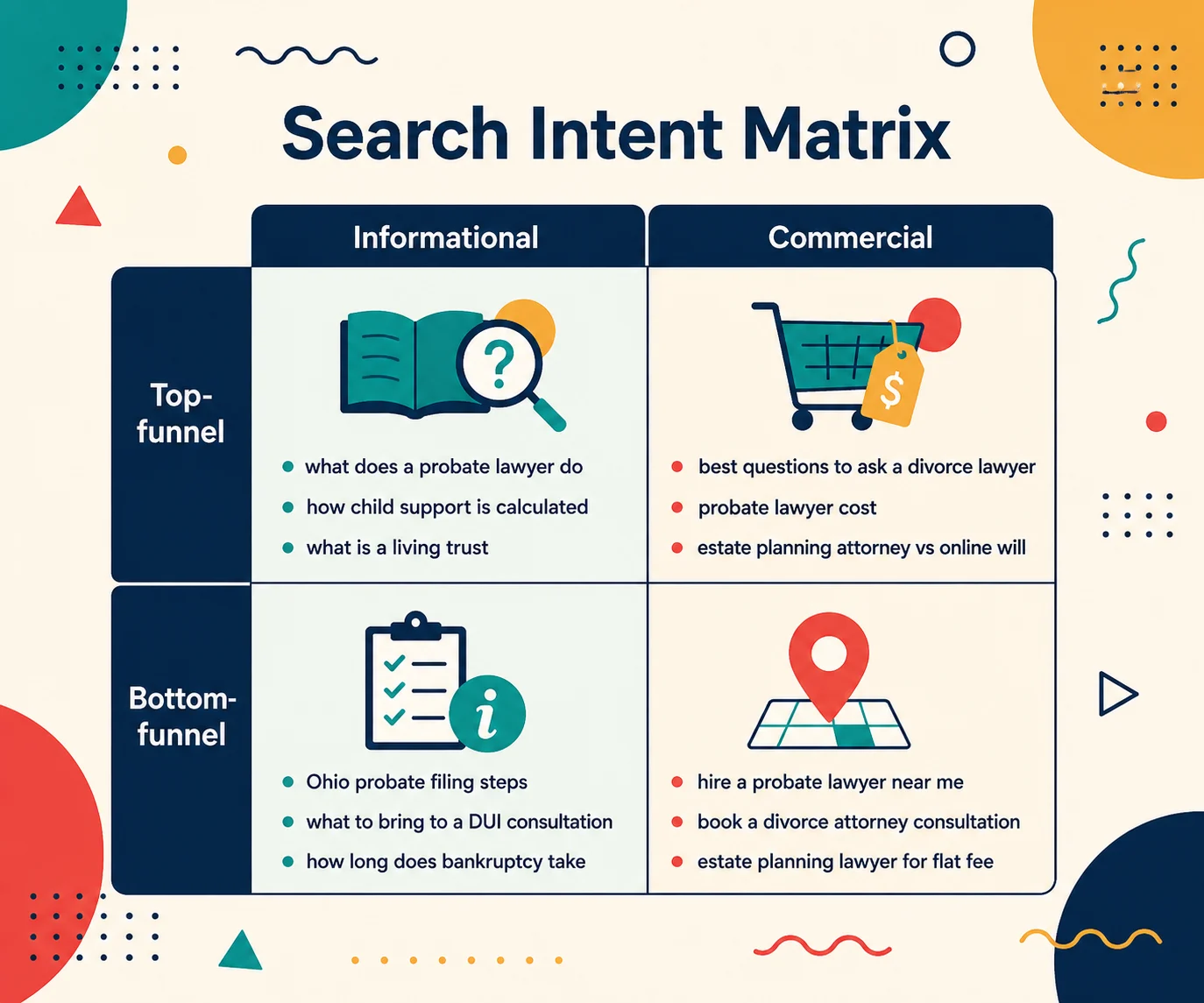
Find winnable keywords — the long-tail high-intent strategy
The right target for a law firm blog is not the head term — it's the long-tail question that has clear local or situational intent. Compare:
- "Personal injury lawyer" — head term, monthly search volume 60K+, intent unclear, ranking competition brutal.
- "How long do I have to file a personal injury claim in Texas" — long tail, monthly search volume ~800, intent crystal clear (someone with a claim, needing SOL info), ranking competition manageable.
The long-tail query has 1/75th the volume but 10x the conversion intent and 1/20th the ranking difficulty. For solo and small firms, that math is overwhelmingly favorable.
Three sources for long-tail keyword research:
- Google Search Console queries report — what you already get impressions for. Often shows ranking opportunities at positions 8–15 that need a content lift to break into top 5.
- "People Also Ask" boxes in Google search results for your head terms. Each PAA question is a long-tail keyword with clear intent.
- AnswerThePublic / AlsoAsked — free or low-cost tools that surface question variants by topic.
The 5 blog post formats that actually rank
Across the attorney blogs I've audited, five post formats consistently outperform everything else:
1. Deep FAQ answers. Pick a single high-intent question — "What happens when a parent dies without a will in Ohio?" — and answer it definitively in 1,500–2,500 words. Statute citations. Court process. Timelines. Real fee ranges. End with a calculator link or a consult CTA. These posts rank for the target question plus 50–100 related long-tail queries.
2. Calculator-paired explainers. "How much does probate cost in Ohio? (With Calculator)" — the page has both a long-form written explanation and an embedded calculator. The calculator drops bounce rate 30–50% and lifts engagement signals, which feeds the SEO ranking. Made For Law's free probate calculator is the embeddable example.
3. State-by-state guides. "Probate Timelines by State," "Statutory Executor Fees by State," "Small Estate Affidavit Thresholds by State." These compound enormously because they capture both the head term ("probate timelines") and 50 state-specific long-tails ("Ohio probate timeline," "Texas probate timeline," etc.).
4. Statute deep-dives. "Ohio Revised Code §2113.35 — Executor Fees Explained." These rank because they're the kind of content other sites link to. Other attorneys, paralegal resources, even Wikipedia editors find and cite well-written statute explainers.
5. Real-case explainers (anonymized). "What happens when an executor doesn't follow the will: a real Ohio case." Strip every identifying detail, use only public-record material if you're citing a specific case, but the case-narrative format ranks because it's first-hand expertise that AI can't fake.
Post structure — the format that ranks
Beyond the topic and depth, the structure matters. Five elements every ranking attorney blog post should have:
- Title tag: target keyword + secondary modifier under 60 characters.
- H1: matches the title intent in plain English.
- First 2 sentences: directly answer the searcher's primary question. Don't bury the answer in paragraph 3.
- Subheadings (H2/H3) that mirror the question and its sub-questions. Use the literal phrasing from Google's People Also Ask if you can.
- Internal links to 3+ related pages: calculator pages, practice-area pages, related FAQ posts.
Schema markup helps too — Article or FAQPage schema marks up the post for Google's structured-data parsers and feeds AI overviews. Most attorney sites have no schema at all on blog posts.
Internal linking — the most underused SEO lever
Internal linking from blog posts to calculator pages and practice-area pages is the cheapest SEO move on the menu and almost nobody does it. Every blog post on a law firm site should have at least 3 internal links — typically:
- One link to the relevant calculator ("see your projected probate cost").
- One link to the primary practice-area page.
- One link to a related blog post.
The compounding effect is real. A new blog post that links to your calculator page passes link equity to it; over months, the calculator page's organic ranking lifts measurably. Multiply across 20 blog posts and you've built a small internal link economy that no agency had to charge you for.
Posting cadence — quality over volume
Solo and small firm cadence: 1–2 posts per month, each 1,500–2,500 words. That's the right tempo. Anything faster usually means thinner posts, and thinner posts rank worse, not better.
Better to publish 18 deep posts a year than 80 thin ones. The 18 deep posts will outrank the 80 thin ones, capture more total search traffic, and convert better.
If you can't write deep posts at that cadence consistently, drop to one post a month or quarterly. Pause publishing entirely is better than publishing scaled-template AI content — Google's classifier demotes domains with scaled content patterns, which can drag down everything else on the site.
A blog that ranks is also a balance-sheet asset; this breakdown of how content sites like law-firm blogs are valued walks through earnings-per-visit, topical authority, and the multiples brokers actually use.

AI-generated content — be very careful
Generative AI for blog content is a real tool, but it's a sharper one than most attorneys realize. Three rules:
- AI-generated content with no editorial expertise added is now an active SEO liability — Google's helpful content classifier demotes it.
- AI as a research and drafting assistant is fine — use it to pull statute references, draft outlines, generate first drafts. The attorney's edits, statute verification, and firsthand expertise are what make the final post rank.
- Never publish AI content unreviewed by the attorney. Beyond SEO risk, hallucinated statute references and case law in AI output are a bar ethics problem.
Practical workflow that works: AI drafts a 1,000-word outline based on Google's PAA + Search Console data, attorney expands and verifies into a 2,000-word post with real expertise and statute citations, paralegal proofreads, publish. Output: 8–12 hours of work for a post that ranks. There's no shortcut that produces ranking posts in 30 minutes — anyone selling that is selling content that won't rank.

Measuring blog SEO — what to track
Four metrics per post, reviewed monthly in Google Search Console:
- Average position for the target keyword and top 5 related queries.
- Impressions — how often the post appears in search results.
- Click-through rate — if CTR is <2% at position <10, the title and meta description need work.
- Click-to-conversion rate — what percentage of blog visitors complete a calculator or fill a form.
Track posts individually for the first 6 months, then portfolio-level metrics. Cut posts that aren't getting impressions after 12 months and consolidate the topic into a stronger deeper post. Pruning thin content lifts the entire domain's authority signals.
How law firm blog SEO fits the rest of the digital marketing stack
Blog SEO doesn't exist in isolation — it's one component of a law firm's broader digital marketing strategy. The blog feeds the rest of the funnel, and the rest of the funnel reinforces the blog's rankings.
Three connection points that turn isolated blog posts into a compounding SEO engine:
- Blog → calculator → consultation. A deep FAQ post links to the embedded calculator, the calculator drives a free consultation CTA, the consultation converts at 20–40%. Tracking the click-through-to-consult rate per post tells you which topics drive matters, not just traffic.
- Blog → practice-area page → contact form. A statute deep-dive links to the practice-area page; the practice-area page is the primary conversion surface for that practice. Both pages benefit — the blog passes link equity, the practice-area page captures intent.
- Blog → email list → nurture. Long-form blog readers are the warmest audience for an email list. A simple opt-in ("Get our monthly probate updates") on every blog post grows the list that converts months later through email nurture.
Family law, personal injury, estate planning, and criminal defense firms all benefit from this stacked-funnel approach. The specifics of which calculator, which practice-area page, and which email sequence change by vertical — the architecture is the same.
Strong SEO content for family law and personal injury blogs — what's different
Different practice areas have different SEO realities. Family law blog SEO and personal injury blog SEO follow the same fundamentals — long-tail, depth, internal links — but with practice-specific tilts worth noting.
Family law attorney blogs rank best on procedural questions: divorce filing requirements by state, custody timelines, alimony calculations, prenup enforceability. The searcher is often researching while emotionally stressed, so post structure matters more than usual — first-sentence answers, clear subheadings, scannable bullets. Avoid jargon. A family law attorney blog with 15 deep posts covering the top procedural questions in one state outranks 80 thin posts every time.
Personal injury lawyers face the toughest blog SEO competition because the head terms ("personal injury lawyer") have huge volume and brutal ranking competition. The winnable plays are: statute-of-limitations posts by state, damages-calculation guides, "what happens after a [type of accident]" explainers, and case-value-range guides. Personal injury attorneys who skip the head terms and own the long-tail consistently outrank competitors twice their size on the queries that actually convert.
The pattern holds across every vertical: skip head terms, own the long-tail, write deeper than your competitors, and add internal links to practice-area pages and calculators.
Technical SEO best practices for law firm blogs
Beyond content, technical SEO and website content health determine whether the blog ranks at all. Most law firm blogs lose ranking signal not from bad writing but from technical decisions that broke years ago and never got fixed.
Five technical SEO best practices for law firm blogs that move search rankings:
- Page speed under 3 seconds. Use tools like Google PageSpeed Insights and GTmetrix to identify the slowest assets. Compress images, defer non-critical scripts, switch to a modern host if the current one is the bottleneck. Slow pages drop search ranking and tank user experience together.
- Mobile-first design. Over 65% of legal search happens on mobile. The blog must be fully responsive — readable line lengths, touch-friendly spacing, no horizontal scrolling. Marketing strategies that ignore mobile leave most prospective client traffic on the table.
- Internal linking depth. Every blog post should link to at least 3 related pages — calculator, practice-area page, related FAQ. This compounds for both SEO (link equity flow) and conversion (website visitors find the next step).
- Schema markup on every post. Article or FAQPage schema feeds search engines and AI overviews. Most attorney sites have none — adding it is a 30-minute setup task with multi-year payoff.
- Image alt text describing the image accurately. Don't stuff keywords; describe the image. Search engines read alt text as a relevance signal for image search and overall page topical depth.
These best practices aren't optional. A blog post with great content but a 9-second mobile load time will lose to a thinner competitor with a 1-second load. Relevance matters, but technical user experience gates everything else.
Keyword research — the work most law firms skip
The keyword research step is what separates blog posts that rank from blog posts that don't. Most law firms either skip this step entirely or do it once at the start of the year and never revisit. The firms that win revisit keyword research every month.
A working keyword research workflow:
- Start with Google Search Console's queries report. Every week, look at what queries your existing pages are already showing for at positions 8–20. These are the position 8–15 opportunities — pages where a content lift breaks you into top 5 with relatively little new work.
- Pull "People Also Ask" questions for each target keyword. Every PAA question is a long-tail keyword with clear intent. A single deep blog post can answer 3–6 PAAs and rank for all of them.
- Validate volume and competition with tools like Ahrefs, Semrush, or Moz. Don't write a 2,000-word post on a 50-volume keyword unless it's a conversion keyword. Don't write a 2,000-word post on a 50,000-volume keyword unless you have the link profile to compete.
- Track Google Analytics conversion data per keyword group. Some keyword clusters drive consults; others drive curiosity-only traffic. Reallocate writing time toward the clusters that drive matters.
Search ranking on the right keyword is the difference between a blog that drives 50 consults a year and one that drives 5. The work is unglamorous; the math is overwhelming. Optimize the keyword research process, optimize the posts themselves, and the search engine rewards the discipline.
Local SEO for law firm blog content — the overlap most firms miss
Most law firm SEO content treats blog SEO and local SEO as separate tracks. They're not — at least not for solo and small firms. Every blog post is an opportunity to reinforce local relevance signals to search engines.
Three tactical overlaps that boost both local SEO and blog rankings simultaneously:
- City/county-specific FAQ posts. "How long does probate take in Ohio?" outperforms "How long does probate take?" on local intent queries — and the city/state-specific post also feeds the firm's local SEO authority.
- Statute deep-dives reference state-specific code. Statute citations like "Ohio Revised Code §2113.35" signal local relevance to Google and to legal-marketing-savvy potential clients reading the post.
- Internal links from blog posts to local practice-area pages. Every state-specific blog post should link to the matching state practice-area page, passing link equity to the conversion surface.
Local SEO and blog SEO compound when they reinforce each other. The firms that treat them as one legal marketing strategy outpace the ones that treat them as two.
Tools and schema markup — the technical foundation
A handful of tools and technical SEO basics make the blog work. None of them are optional for a firm serious about organic traffic:
- Google Analytics for traffic and engagement. Free, gets the job done. Set up conversion tracking on calculator completions and consult form submissions on day one.
- Google Search Console for query data, impressions, and the position 8–15 opportunities report (queries where you're almost ranking but need a content lift to break top 5).
- A keyword research tool — Ahrefs, Semrush, or Moz at the higher end; free alternatives (AnswerThePublic, Google's keyword planner) at the entry level. The point is to validate search volume and competition before writing the post, not after.
- Schema markup — Article, FAQPage, HowTo, LegalService. Most attorney blog platforms (WordPress + Yoast/RankMath, or Webflow with native schema) generate schema markup automatically once configured. Schema markup feeds Google's structured-data parsers and increasingly feeds AI overviews.
Comprehensive SEO for a law firm blog isn't a one-time project — it's a cadence. The firms that win treat blog SEO the way they'd treat case management software: pick the tools, set up the workflow once, then execute consistently for years. That's the entire law firm SEO strategy in one sentence.
Disclaimer: This article is for general educational purposes only and does not constitute legal advice. Made For Law is not a law firm, and our team are not attorneys. We are not affiliated with any federal, state, county, or local government agency or court system. Content may be researched or drafted with AI assistance and is reviewed by our editorial team before publication. Laws change frequently — always verify information with official sources and consult a licensed attorney for advice specific to your situation. Full disclaimer
- Google's helpful content guidancedevelopers.google.com
- how content sites like law-firm blogs are valuedrealsiteworth.com

Alex Tarlescu is co-founder of Made For Law — the SaaS platform that gives attorneys embeddable legal calculators with built-in lead capture. He's also co-founder of Good Smart Idea, the sister marketing agency that handles broader marketing engagements for law firms. Based in Cleveland with nearly 20 years of experience in sales, digital marketing, and AI automation, he writes about marketing — not legal advice — and the systems that turn website visitors into signed clients.