

Why most law firm ROI tracking is broken
Walk into any solo or small law firm and ask "what was your marketing ROI last quarter?" — and most attorneys will give you a number that's either guessed or based on a single channel. The honest answer is usually "I don't really know."
Three structural reasons for the gap. First, legal buyers have long research windows — they read 3–7 sites over a week before contacting any firm, which means the last-touch channel (where they actually contacted you) often gets credit for work the first-touch channel did. Second, most firms have no call tracking, so the largest source of new business — phone calls from GBP and direct search — is invisible in the marketing dashboard. Third, lead-to-signed conversion isn't tracked back to source, so the firm can't tell which channel sends paying clients vs which sends tire-kickers.
Fixing this isn't expensive. Three tools, ~$80–$300/month total, plus a monthly 30-minute reconciliation routine. Below is the setup.
The three metrics that actually matter
Cost per lead (CPL). Marketing spend ÷ leads generated. Spend $2,000 on Google Ads, get 25 leads, CPL is $80. Useful as a first cut by channel — see CPL benchmarks for legal-specific ranges.
Cost per signed case (CPC). Marketing spend ÷ retained clients. This is the number that decides whether the campaign is profitable. CPC = CPL × (1 ÷ lead-to-signed rate). At 5% conversion, an $80 CPL = $1,600 per signed case.
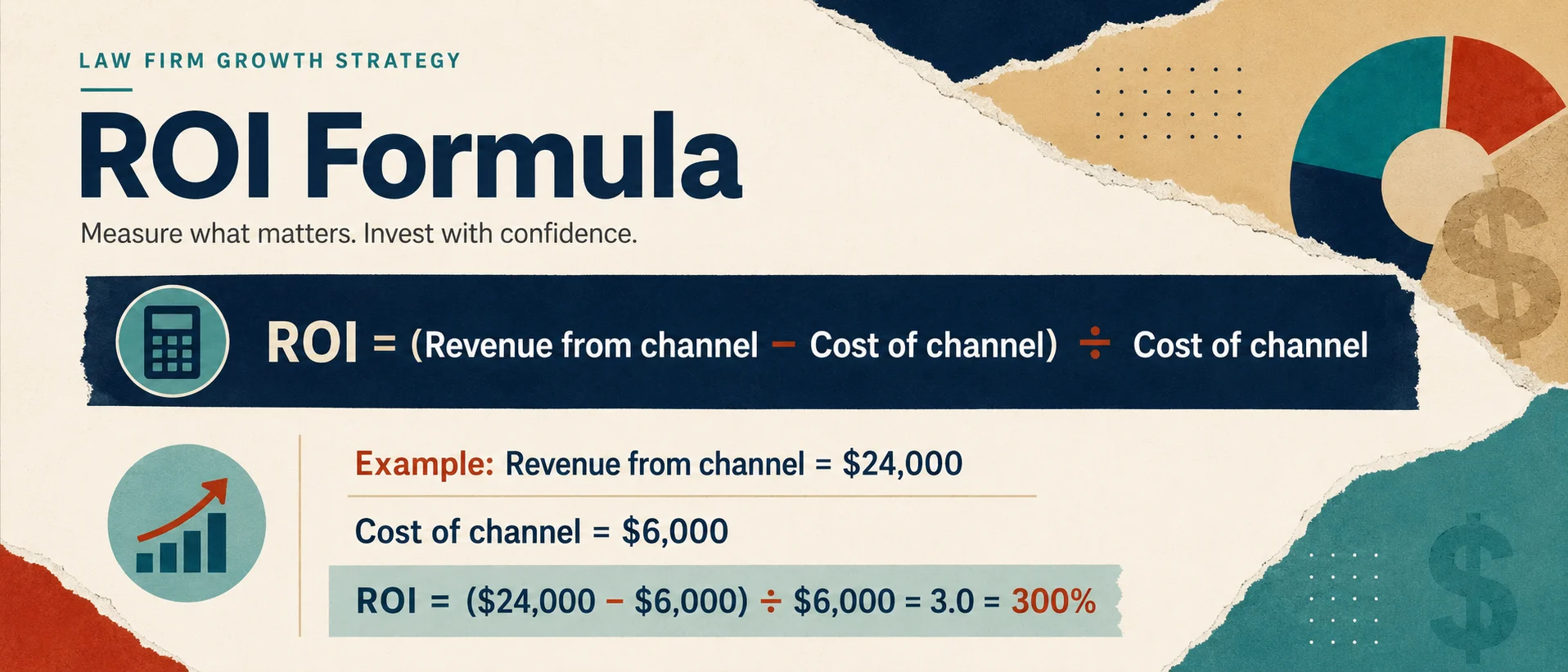
Marketing ROI. Revenue from new clients ÷ marketing spend × 100. ROI < 200% is poor (you're not making your marketing dollars back at acceptable margins). 300–500% is solid. 700%+ is excellent.
These three roll up together. CPL by channel + lead-to-signed by channel = CPC by channel. CPC × case count + average case value = marketing-driven revenue. Marketing-driven revenue ÷ spend = ROI.
The lean tracking stack
1. [Google Search Console](https://search.google.com/search-console/about) (free) — organic traffic, query-level impressions, click data, and ranking position. Connect to Google Analytics 4 for full funnel reporting.
2. CallRail (`$50–$200/mo`) — dynamic phone numbers per traffic source. A unique number for Google Ads, GBP, organic, direct, referral. Phone calls map to source automatically. This is the single biggest fix for legal ROI tracking — without it, the largest lead source is invisible.
3. CRM with source tagging — Practice management platforms (Clio Grow, Lawmatics, MyCase) handle this natively. Standalone CRMs (HubSpot Free, Pipedrive) work too with UTM tagging on form fills.
Optional add-ons once the core stack is humming:
- GA4 for site analytics — free, but the GA4 setup curve is steeper than the old Universal Analytics. Worth the effort.
- A CRM-to-spreadsheet sync for monthly reconciliation — Zapier or Make.com handle this for $20–$80/mo`.
Lead source attribution — the part most firms skip
Source attribution is where the tracking actually pays off. Every lead in the CRM needs a source tag — Google Ads, organic, GBP, referral, direct, or "other." Three ways to capture it:
- UTM parameters on every external link. Google Ads ads, email campaigns, retargeting ads, directory listings — each gets a unique UTM tag that surfaces in the CRM when the lead fills a form.
- Dynamic phone numbers via CallRail. A unique number per channel routes calls and reports the source.
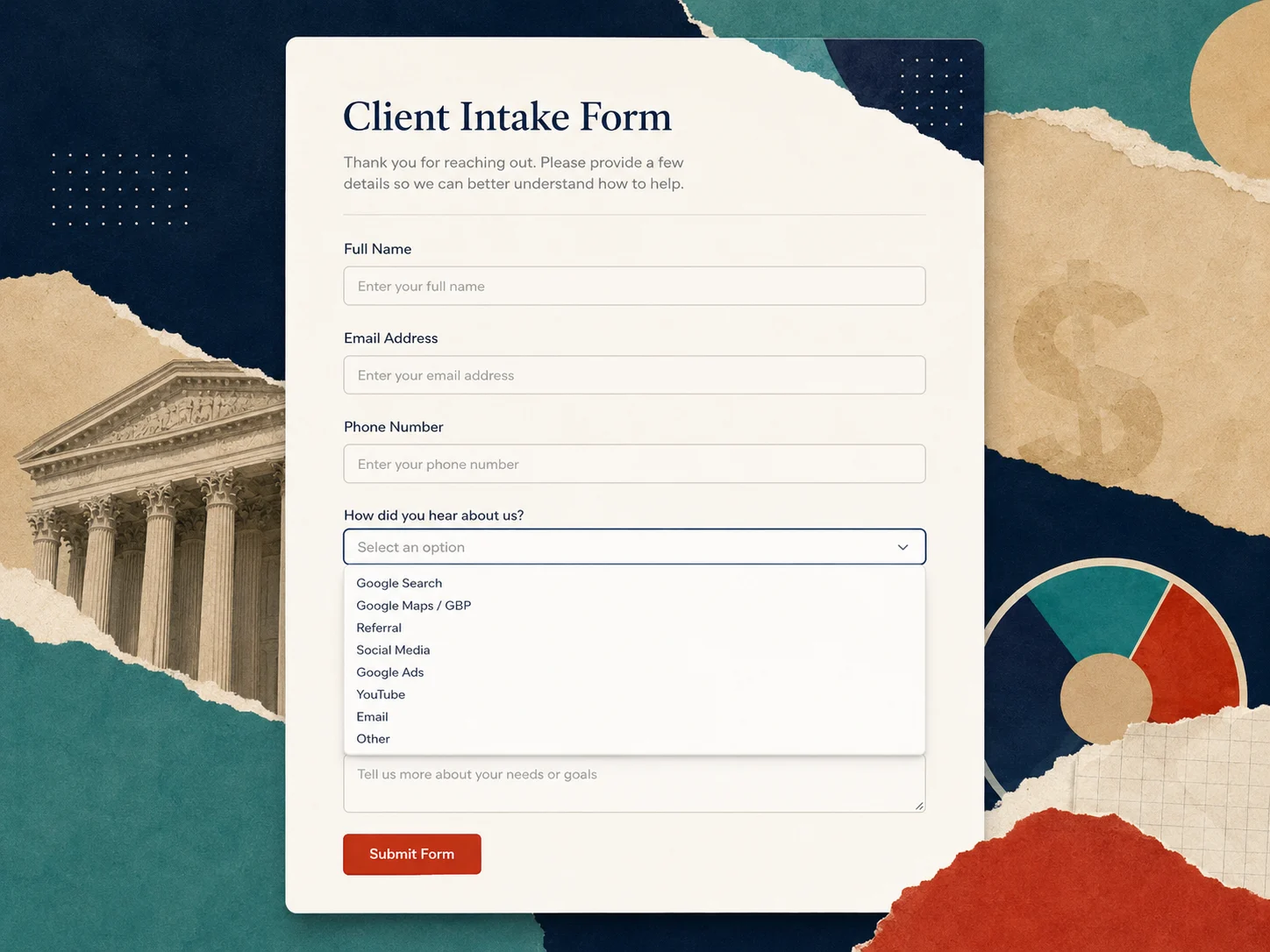
- Manual source field on intake. "How did you hear about us?" on the intake form — kept optional to avoid friction. About 30–50% of leads will fill it, which is enough to validate the digital tracking.
Without source tagging, every lead defaults to "unknown," and the ROI math breaks. With tagging, you can compute CPL per channel, lead-to-signed rate per channel, and CPC per channel — the three numbers that decide where to spend more.
First-touch vs last-touch attribution
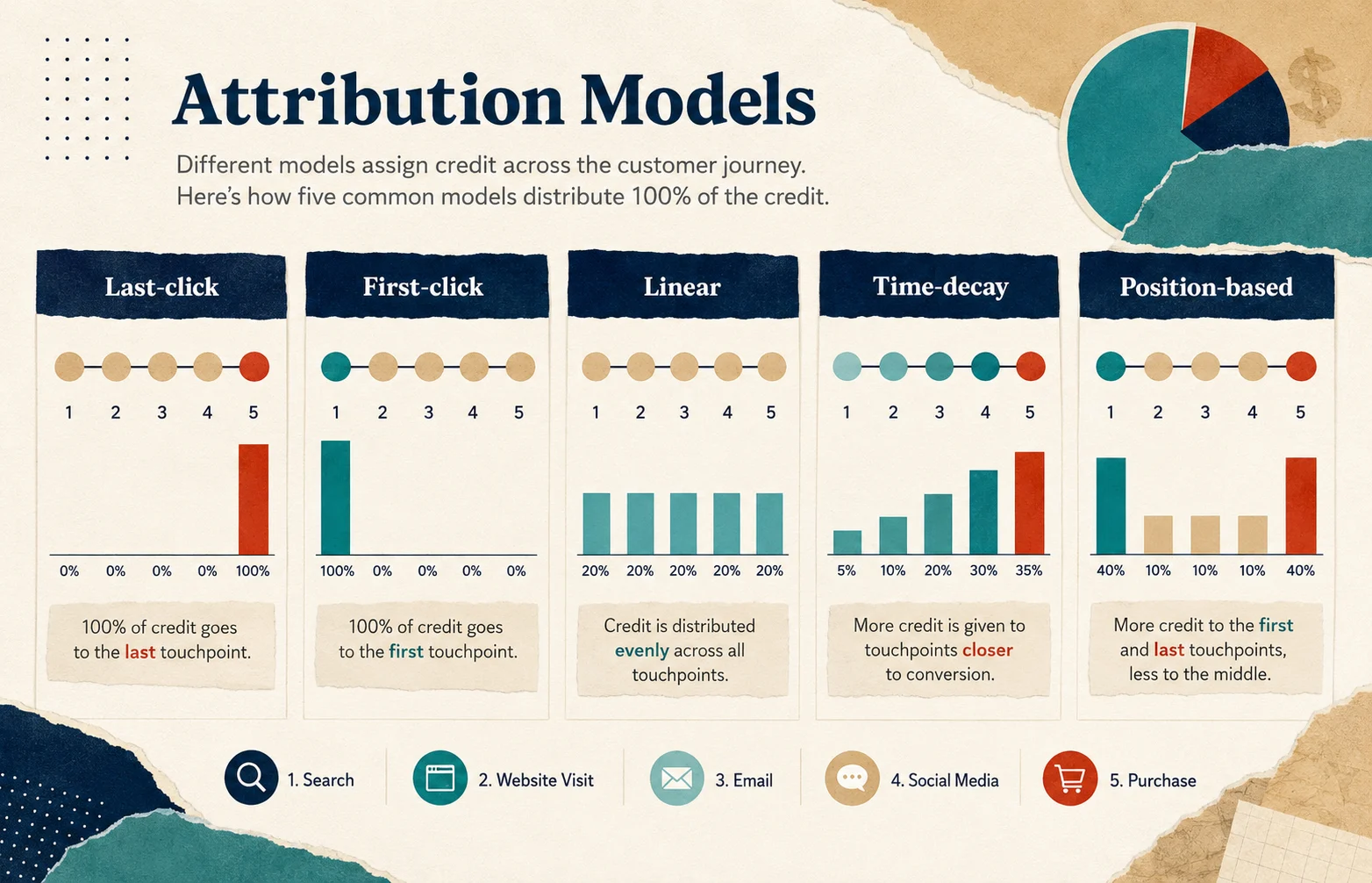
Legal buyers research 3–7+ days before contacting a firm (iLawyer Marketing). That means the channel where they first encountered you is often different from the channel they last clicked through on. Two attribution models, both useful for different reasons:
- Last-touch (most common) — credits the final channel before the form fill or phone call. Easy to implement. Tends to over-credit direct traffic and branded organic.
- First-touch — credits the channel where the visitor first arrived. Better for measuring top-of-funnel awareness work like content and educational ads.
For solo firms, last-touch is the default and is fine for the majority of decisions. But when evaluating top-of-funnel content (blog posts, retargeting awareness ads), first-touch is the right view. GA4 supports both — and tools like Wicked Reports go deeper if budget allows (usually overkill at solo scale).
The disagreement between models can run 20–40%. A channel that looks like 5% of conversions on last-touch may be the first touch on 25% of conversions. Don't kill a channel based on last-touch alone — check both.
The monthly reconciliation routine
Once a month, 30 minutes, in this order:
1. Pull leads from the CRM by source. Count for the month. Confirm sources match expected channels.
2. Pull signed retainers by source. Same CRM, filtered to "engaged" or "matter open." Compute lead-to-signed rate per channel.
3. Pull spend by channel. Google Ads, Meta Ads, directory subscriptions, any agency retainer. Sum the total.
4. Compute CPC per channel = Spend ÷ signed cases.
5. Compute marketing ROI = (Signed cases × Average case value) ÷ Spend × 100.
6. Compare CPC to acceptable threshold per channel — typically <10% of average case value. Anything above means the channel is unprofitable or the conversion rate is too low.
Most firms see one channel that's clearly underperforming after the first reconciliation. Cut the spend on that channel and reallocate. The second reconciliation usually shows the next bottleneck.
Common ROI tracking mistakes
Five patterns I see across solo and small firm marketing dashboards:
1. No call tracking. GBP and direct-search calls vanish from the dashboard. Without CallRail or equivalent, ROI tracking is fundamentally broken.
2. Conflating impressions with reach. A campaign with 100K impressions and 3 signed cases isn't a "high-awareness" success — it's an expensive ad spend. Track conversions, not impressions.
3. Quarterly reconciliation instead of monthly. Decision lag of 90 days means you waste a quarter of ad spend on a failing channel.
4. Ignoring referrals in the math. Referrals convert at 25–40% — the highest rate of any source. They're free (or low-cost to maintain) and most firms don't track them as a marketing channel. They should be the benchmark every paid channel is measured against.
5. Vanity-metric optimization. Total website visits, total social followers, total impressions — none of these correlate with retained clients at solo scale. CPC and ROI are the only metrics worth optimizing.
What good ROI looks like in 2026
Rough ranges for solo and small firms across practices:
- Marketing ROI 300–500% = solid; the marketing operation is profitable.
- 500–700% = strong; firm is reinvesting profitably and likely scaling.
- 700%+ = excellent; usually combines mature SEO + GBP + referrals + targeted paid ads.
- <200% = unprofitable; either the channels are wrong or the conversion is broken.
Practice area matters. Estate planning firms tend to run higher ROIs than PI because case values are lower but conversion windows are shorter. PI firms can hit higher absolute revenue per signed case but accept lower ROIs because acquisition costs are higher.
Pair ROI tracking with calculator-driven lead capture (Made For Law's free probate calculator or the paid for-law-firms embed) and the conversion-rate side of the equation lifts dramatically — which is usually the easier lever to move than the spend side.

Disclaimer: This article is for general educational purposes only and does not constitute legal advice. Made For Law is not a law firm, and our team are not attorneys. We are not affiliated with any federal, state, county, or local government agency or court system. Content may be researched or drafted with AI assistance and is reviewed by our editorial team before publication. Laws change frequently — always verify information with official sources and consult a licensed attorney for advice specific to your situation. Full disclaimer
- Google Search Consolesearch.google.com

Alex Tarlescu is co-founder of Made For Law — the SaaS platform that gives attorneys embeddable legal calculators with built-in lead capture. He's also co-founder of Good Smart Idea, the sister marketing agency that handles broader marketing engagements for law firms. Based in Cleveland with nearly 20 years of experience in sales, digital marketing, and AI automation, he writes about marketing — not legal advice — and the systems that turn website visitors into signed clients.