
Where the Standard Came From
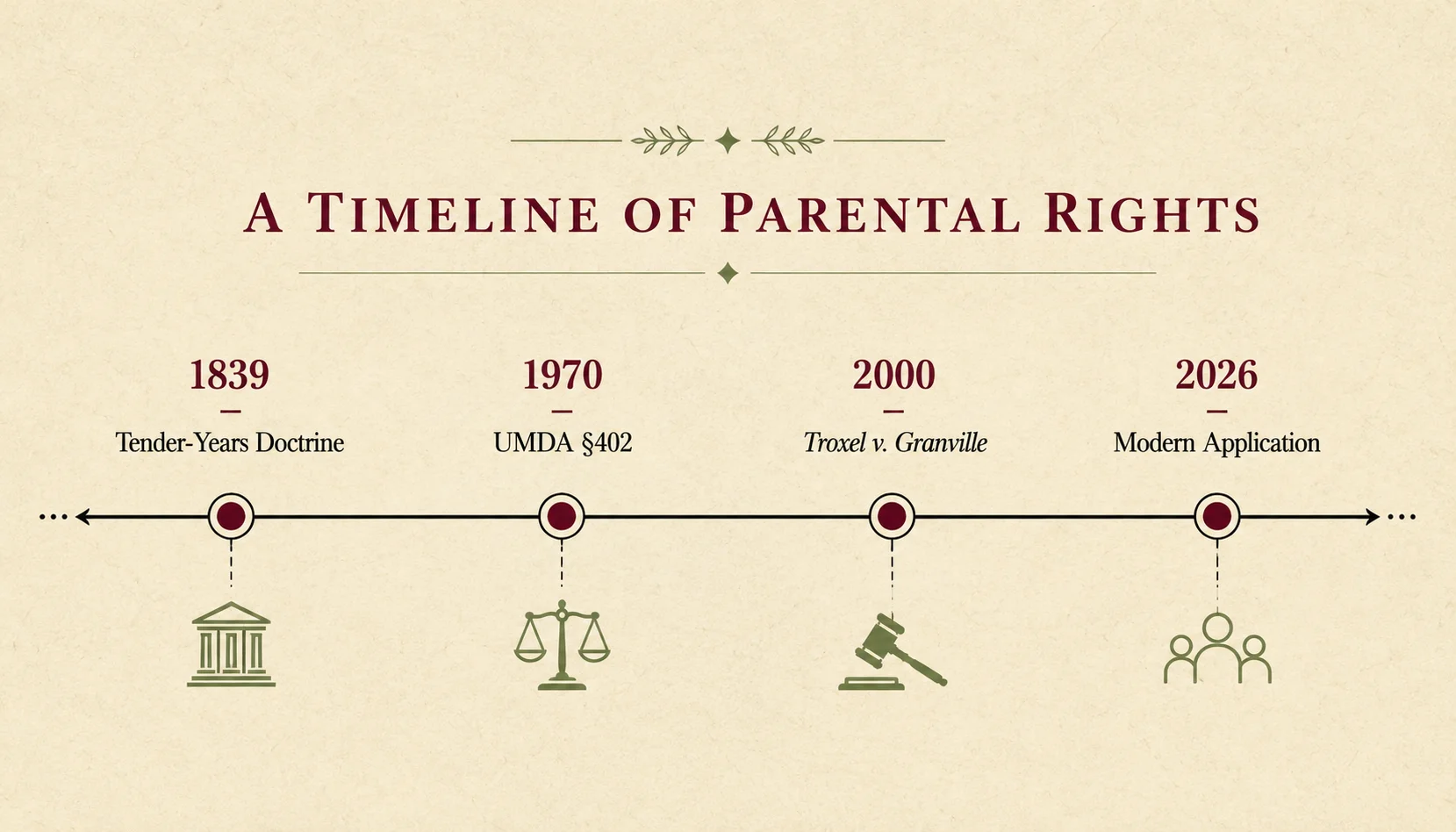
The best-interests-of-the-child standard — BIOC — is now the default rule in every US state. But it wasn't always. Through most of the 1800s, fathers held a presumptive right to custody; the early 1900s tender-years doctrine flipped that to mothers for young children. BIOC, as we know it, traces to the Uniform Marriage and Divorce Act §402 (UMDA, 1970) — a model statute most states adapted in some form during the 1970s and 1980s.
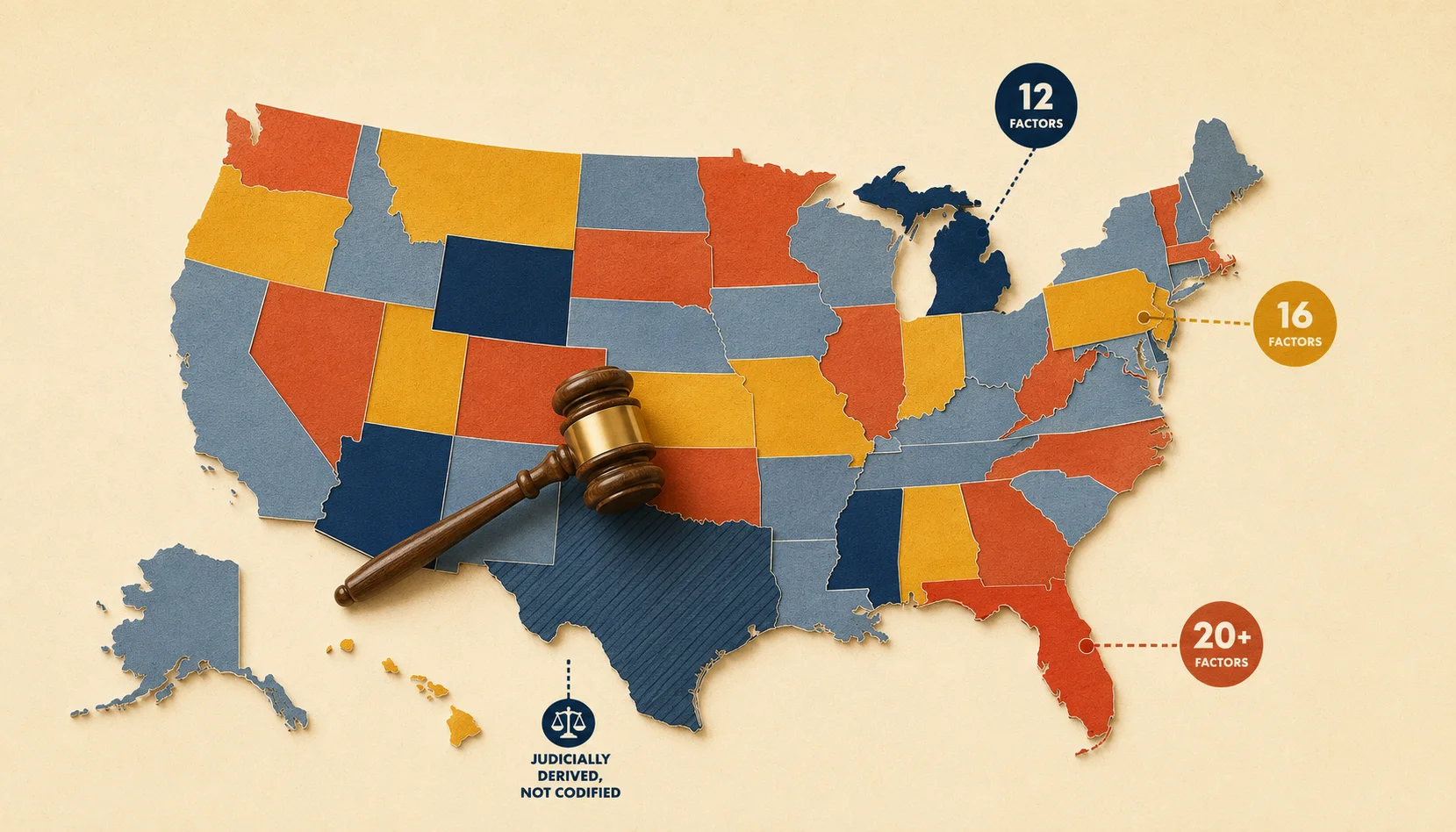
UMDA §402 listed five factors. States expanded — Michigan codified 12, Florida codified 20+, Pennsylvania pushed to 16. Even today, there's no single national checklist; you have to read your state's statute.
State Factor Lists — A Working Map
Michigan — MCL §722.23 lists 12 factors: love and affection, capacity to provide guidance, capacity to provide food/clothing/medical care, length of time in stable environment, permanence of the family unit, moral fitness, mental and physical health, home/school/community record, child's preference if of sufficient age, willingness to facilitate parent-child relationships, domestic violence history, and any other relevant factor.
California — Family Code §3011 and §3020 — fewer enumerated factors than Michigan but with a strong public-policy preference for frequent and continuing contact with both parents, subject to safety carve-outs.
Florida — §61.13(3) — 20+ factors including mental and physical health, moral fitness, capacity to provide a consistent routine, evidence of domestic violence, and any other factor the court deems relevant.
Texas — uses the Holley factors from Holley v. Adams, 544 S.W.2d 367 (Tex. 1976), a judicial framework codified into practice rather than statute: emotional/physical needs, danger now and in the future, parental abilities, programs available, plans for the child, stability of home, parental acts or omissions, and any excuse for those acts.
Pennsylvania — 23 Pa.C.S. §5328 — 16 factors, with explicit weight given to the parties' history of cooperation.
Ohio — ORC §3109.04(F) — 10 enumerated factors plus an open clause, with explicit deference to the child's wishes if 13 or older in some courts.
Illinois — 750 ILCS 5/602.7 reframed custody as "allocation of parenting time" in 2016 — the substantive analysis still tracks BIOC factors.
New York — DRL §240 is less factor-driven and more totality-of-circumstances; New York courts cite Eschbach v. Eschbach (1982) for the operative test.
How Courts Weigh Competing Factors
Here's the thing — factor lists don't tell you which factor wins when two pull opposite ways. The statutes are usually silent on weighting, and judges apply discretion. A parent with a stable home but a recent DUI versus a parent with a less stable home but a clean record — the statute doesn't decide that. The judge does.
Some patterns hold across jurisdictions: domestic violence findings usually trump most other factors (Michigan, Florida, and California all give it explicit elevated weight), stability of the existing arrangement tends to win in close cases (the "status quo bias"), and a child's stated preference matters more as they age — typically 12+ in most states.
Honestly — the same fact pattern can produce different custody outcomes in two adjacent counties. That's not a bug of the system; it's the design. BIOC is intentionally elastic.

Where Forensic Psychology Enters the BIOC Analysis
Most courts hear BIOC factors through three filters: testimony from the parents themselves, testimony from collateral witnesses, and — in roughly ~40% of contested cases — a forensic custody evaluation report.
The evaluator's job is to translate the statutory factors into clinical observations. The APA Guidelines for Child Custody Evaluations require that conclusions trace back to specific data sources — so if a Michigan evaluator opines on factor 9 (preference of the child), the report should document the interview that produced that preference.
The AFCC Model Standards similarly insist on factor-by-factor traceability. When you see a custody report that doesn't trace cleanly to your state's factor list, that's a cross-examination opening — see our forensic psychology in child custody guide for how attorneys use that gap.

The Therapeutic Jurisprudence Critique
Starting in the early 1990s, a body of academic work — Wexler and Winick's Essays in Therapeutic Jurisprudence and the International Society for Therapeutic Jurisprudence — pushed back on whether BIOC is the right standard at all. Their argument: courts are bad at predicting future welfare, and BIOC's elasticity invites bias.
Gregory DeClue's 2001 paper — "Best Interests of the Village Children" — picked up the thread, criticizing the way forensic evaluators apply BIOC: assessing factors they can't measure, recommending outcomes they can't validate. The paper still circulates in cross-examinations today.
Emery, Otto and O'Donohue followed with a 2005 critical assessment — they argued that custody recommendations often exceed what the underlying data supports. Roughly 30–40% of evaluators in their dataset gave recommendations on factors they hadn't directly assessed. Krauss and Sales had made a similar argument in 2000.
None of this has changed the statutes. BIOC is still the law. But the academic critique is what gives a good attorney their cross-examination playbook.

Common Misconceptions
"My kid is 12 — they get to pick." No state lets a child pick unilaterally. Statutes give weight to the preference of children of sufficient age — usually 12+ — but the judge decides how much weight. A persuasive preference might shift a close case; it won't override domestic violence or abuse findings.
"Mothers always win." False since the 1970s. The tender-years doctrine has been formally rejected or struck as unconstitutional in every state. Statutory presumptions are gender-neutral.
"Religion can't be a factor." Religion can be considered when it affects the child — health decisions, schooling, social isolation — but courts can't choose between parents on the basis of religion. The Troxel v. Granville, 530 U.S. 57 (2000) framework limits state intrusion on parental religious choice in fit-parent cases.
"Best interests means "happy."" It doesn't — every state statute talks about safety, stability, and developmental needs first. Happiness in the short term is rarely the controlling factor.
The International View — UN Convention Article 3
Article 3 of the UN Convention on the Rights of the Child (UNCRC) establishes the best-interests principle as the primary consideration in all child-related decisions made by public and private institutions. 196 countries have ratified the Convention. The US signed it in 1995 but has never ratified — so UNCRC Article 3 isn't binding domestic law in the US.
Where it shows up — Hague Convention cases under the Hague Convention on the Civil Aspects of International Child Abduction, which the US has ratified. In Hague return analysis, best-interests considerations enter through narrow exceptions (Article 13(b) grave-risk defense), not as the primary test.

How Judges Apply the Standard in Practice
When a parent asks the court to set or modify custody and visitation, the court may rule only after it has considered the statutory factors. In most states the judge must consider every enumerated factor on the record — skipping factors is reversible error. A court may grant primary physical custody of the child to one parent while ordering shared decision-making, or split it the other way; the child's best interest controls, not parental convenience. The judge may also issue a temporary custody order before trial in custody disputes that involve allegations of child abuse or domestic violence.
Parents who make decisions together — about schooling, medical care, religion, the visitation schedule, and child support — fare better when factor lists score "willingness to cooperate." Judges read a refusal to communicate as evidence of poor co-parenting capacity. Either parent can move to modify custody decisions when the child's needs change — California custody modification motions and similar relief in other states require a material change of circumstances. The child's age, the child's preference (in states that weight it), the child's emotional and child's health considerations, and each parent's relationship with the child all feed the analysis.
Federal resources — the Child Welfare Information Gateway publishes a state-by-state guide to the "best interests of the child" factors, and the phrase "best interest of the child" appears in nearly every state statute. The dispute may also touch the child's other parent's role: in joint-legal-custody states the non-custodial parent retains decision rights on schooling, religion, and non-emergency medical care.

What This Means If You're In a Contested Custody Case
Three practical takeaways. First — pull your state's factor statute and read it before any hearing. Your attorney should map every fact to a specific factor. Generic "my kid is better off with me" doesn't survive cross-examination.
Second — if a custody evaluator is involved, ask whether their report ties back to your state's factor list factor-by-factor. If it doesn't, that's a Daubert opening under FRE 702.
Third — track time. The custody time calculator gives you a rough picture of how parenting-time splits affect support and tax-filing status. Numbers matter to judges.

Disclaimer
Made For Law is not a law firm. Statutes change; case law develops; your state's procedural rules can shift the analysis. This article is editorial and educational only. Consult a licensed family law attorney in your jurisdiction for guidance specific to your case.
Disclaimer: This article is for general educational purposes only and does not constitute legal advice. Made For Law is not a law firm, and our team are not attorneys. We are not affiliated with any federal, state, county, or local government agency or court system. Content may be researched or drafted with AI assistance and is reviewed by our editorial team before publication. Laws change frequently — always verify information with official sources and consult a licensed attorney for advice specific to your situation. Full disclaimer
- Uniform Marriage and Divorce Act §402uniformlaws.org
- MCL §722.23legislature.mi.gov
- Family Code §3011leginfo.legislature.ca.gov
- §3020leginfo.legislature.ca.gov
- §61.13(3)leg.state.fl.us
- Holley v. Adams, 544 S.W.2d 367 (Tex. 1976)casetext.com
- 23 Pa.C.S. §5328legis.state.pa.us
- ORC §3109.04(F)codes.ohio.gov
- 750 ILCS 5/602.7ilga.gov
- DRL §240nysenate.gov
- APA Guidelines for Child Custody Evaluationsapa.org
- AFCC Model Standardsafccnet.org
- Essays in Therapeutic Jurisprudencelawcat.berkeley.edu
- International Society for Therapeutic Jurisprudenceintltj.com
- "Best Interests of the Village Children"thelizlibrary.org
- 2005 critical assessmentjournals.sagepub.com
- argument in 2000psycnet.apa.org
- Troxel v. Granville, 530 U.S. 57 (2000)supreme.justia.com
- UN Convention on the Rights of the Childohchr.org
- Hague Convention on the Civil Aspects of International Child Abductionhcch.net
- FRE 702law.cornell.edu

Our editorial team researches and summarizes publicly available legal information. We are not attorneys and do not provide legal advice. Every article is checked against current state statutes and official sources, but you should always consult a licensed attorney for guidance specific to your situation.