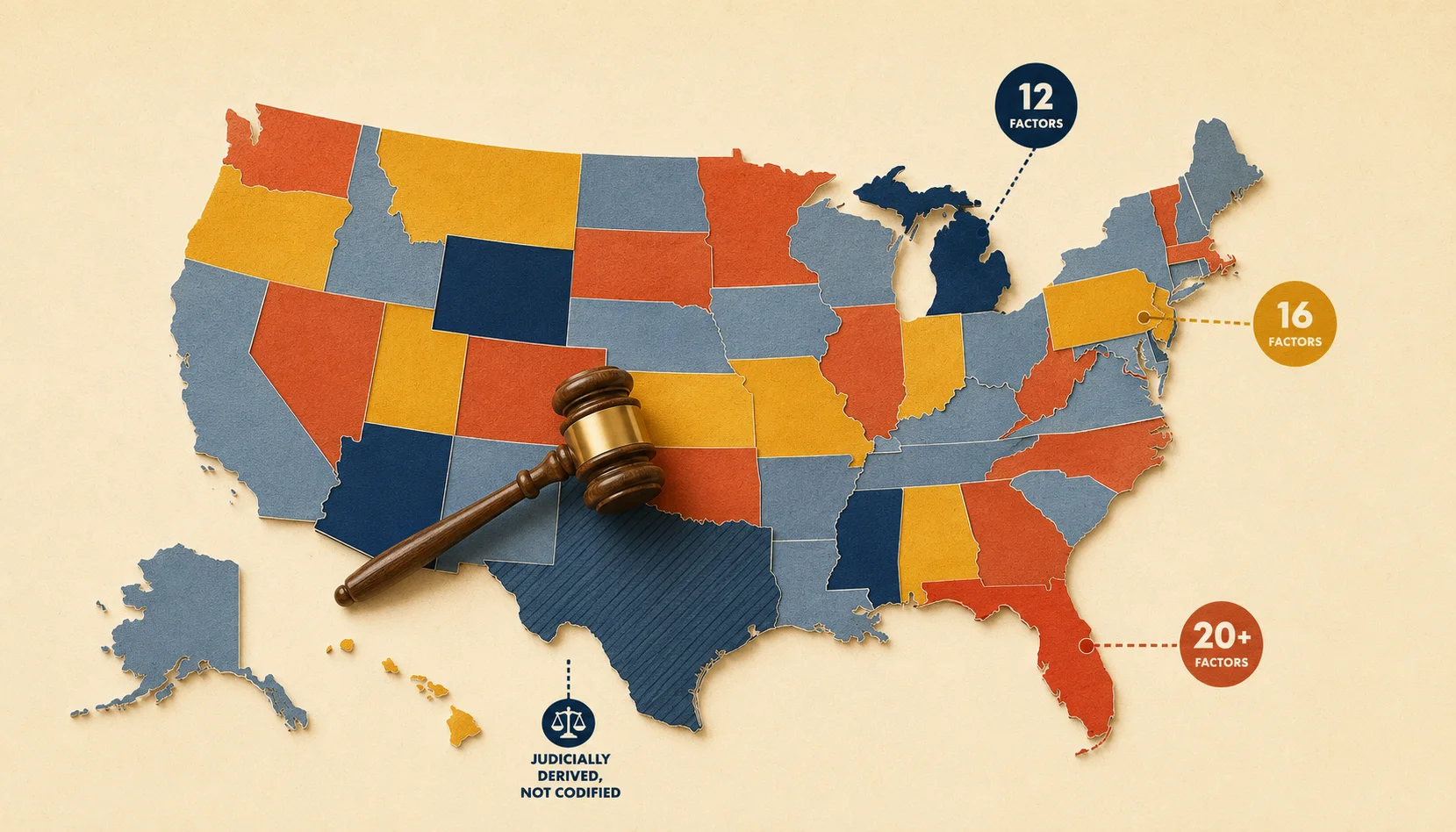

The Forensic Psychologist's Role in a Child Custody Case
A forensic psychologist in a custody case usually plays one of two roles. The first — court-appointed (or stipulated) neutral evaluator who produces the custody evaluation report for the judge. The second — a privately retained expert hired by one side to consult, critique the neutral's report, and potentially testify at trial.
Both roles are governed by the APA Specialty Guidelines for Forensic Psychology (2013) and the APA Ethical Principles. The two roles have different ethical contours — the neutral evaluator owes their duty to the court; the retained expert owes a duty of objectivity even while being paid by one side.

When Family Law Attorneys Retain a Forensic Psychologist in a Custody Dispute
Three triggers, mostly. First — when the opposing parent's mental health is in play (alleged substance abuse, untreated personality disorder, or psychiatric hospitalization history). Second — when a court-appointed evaluator's report cuts against your client and you need a peer-level expert to challenge methodology. Third — when allegations of alienation, abuse, or coercive control require specialized assessment.
Cost runs $300–$600/hour with a typical $5,000–$15,000 retainer. Trial testimony day rates run $2,500–$5,000. A full engagement — review, written critique, deposition, trial testimony — usually lands $15,000–$50,000. The American Academy of Matrimonial Lawyers publishes occasional surveys with regional ranges.
Is it worth it? Depends on what's at stake. In a 50/50 vs primary-custody fight, a strong expert can shift the outcome. In a weekend visitation dispute, the math rarely works.

Credentialing — What Actually Counts
Three credentials matter. First — a current state psychology license. Verify it through your state's Board of Psychology or the Association of State and Provincial Psychology Boards (ASPPB). License lapses, complaints, and disciplinary actions are public.
Second — ABPP forensic specialty board certification. It's earned through peer review of work samples plus an oral examination. Fewer than ~1,000 US psychologists hold it. Many good evaluators don't — but ABPP is a strong signal.
Third — membership in the American Academy of Forensic Psychology (AAFP), which requires ABPP forensic diplomate status. Open Access Journal of Forensic Psychology (oajfp.com) publishes peer-reviewed work that's often cited at trial.
What doesn't count — "Certified Custody Evaluator" credentials from for-profit weekend trainings. Anyone can hang that on a wall. ABPP and state licensure are the real filters.

Daubert and Admissibility — The Trilogy
Expert psychological testimony in federal court (and most state courts that follow the federal model) gets admitted or excluded under the Daubert trilogy. Daubert v. Merrell Dow Pharmaceuticals, 509 U.S. 579 (1993) — judges act as gatekeepers, applying reliability factors (testable, peer-reviewed, known error rate, generally accepted).
General Electric Co. v. Joiner, 522 U.S. 136 (1997) — appellate courts review exclusion decisions only for abuse of discretion. Kumho Tire Co. v. Carmichael, 526 U.S. 137 (1999) — Daubert applies to all expert testimony, not just "scientific" testimony.
Operationally — FRE 702 and FRE 703 are the statutory hooks. The Federal Judicial Center Reference Manual on Scientific Evidence is the standard practitioner reference judges actually consult. State courts vary — most have adopted Daubert; a minority still follow Frye general-acceptance.
Cross-Examining a Custody Evaluator in Child Custody Disputes — The Playbook
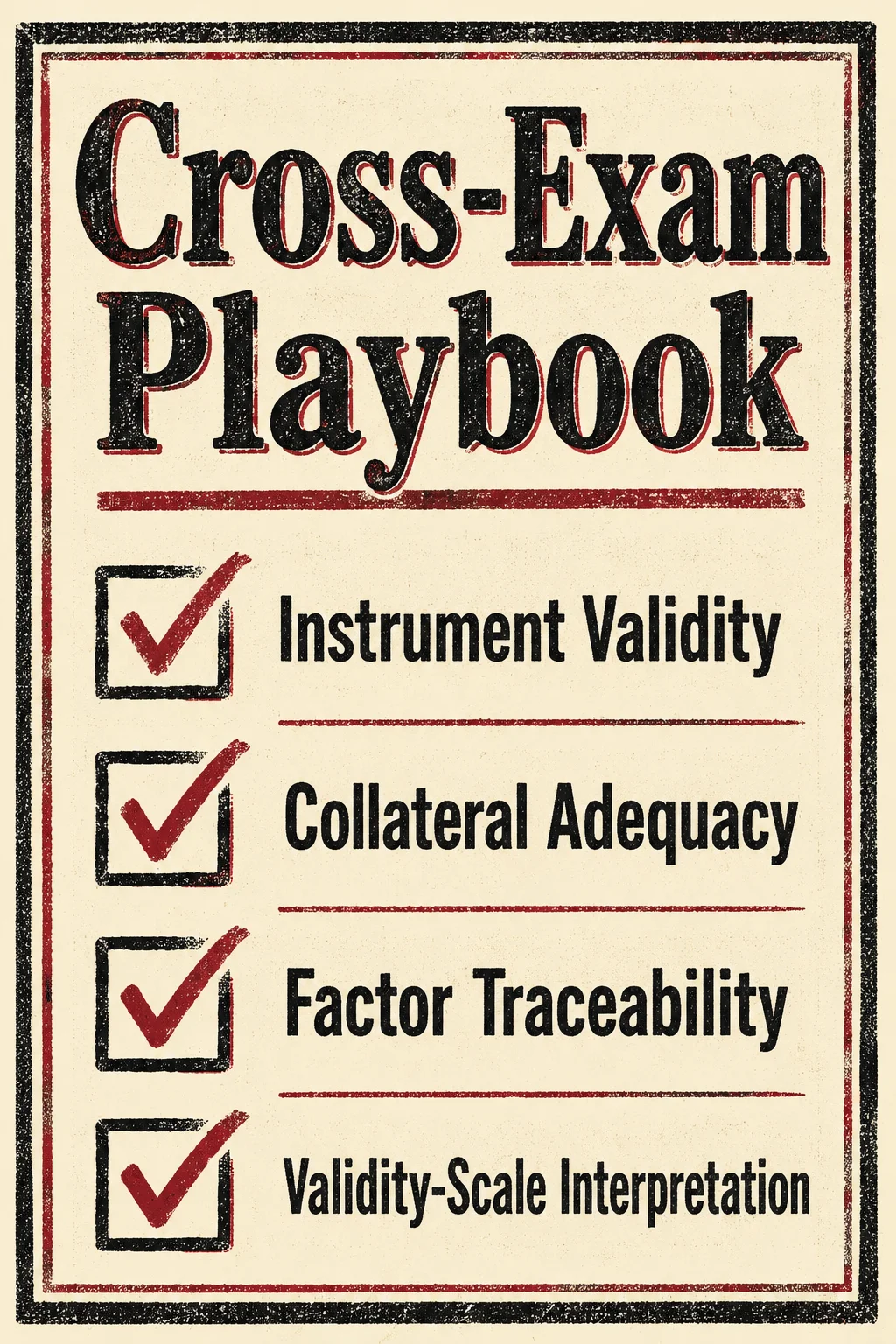
The standard cross-examination targets four weaknesses. First — instrument validity. Was the MMPI-2 normed on custody-disputing parents? No, it wasn't. The Wood et al. (2007) critique gives your attorney the citation chain.
Second — collateral interview adequacy. How many collateral sources did the evaluator interview? If the answer is < 3 and they're all immediate family, the report may not meet the AFCC Model Standards.
Third — factor-by-factor traceability. Did the recommendation trace cleanly to your state's best-interests factors? If recommendations exceed what the data supports — the Emery/Otto/O'Donohue 2005 critique and Tippins/Wittmann 2005 — that's a Daubert opening.
Fourth — validity-scale interpretation. Did the evaluator dismiss elevated L, F, or K scales on the MMPI? Did they ignore PAI inconsistency indicators? Those are the technical anchors that move a judge.
Ziskin and Faust's *Coping with Psychiatric and Psychological Testimony* is the go-to cross-examination manual — your attorney probably owns a copy.
The Brodsky/McKinzey Ethical Confrontation Framework — Conducting Child Custody Evaluations Ethically
When an evaluator has acted unethically — fabricated collateral interviews, fabricated tests, retained dual roles that conflict — the standard professional response is the Brodsky & McKinzey (2002) ethical confrontation. The framework: formal, evidence-based, on-record. Not a blog post; not a letter to the judge. A documented record that builds toward a licensing-board complaint if the confrontation doesn't resolve.
The procedure runs roughly: identify the specific ethical violation with reference to the APA Ethics Code, document the evidence, present it to the colleague directly (in writing) with an opportunity to respond, and — only if the response is inadequate — escalate to the licensing board or court.
It's not a litigation tactic. It's a professional-ethics tool. But when it surfaces in custody litigation — and it occasionally does — it carries weight precisely because it's the established framework rather than ad-hoc attack.

Engagement Structure for Forensic Psychologists in Family Court — Retainer, Hourly, Trial Day Rates
Most forensic experts work on a retainer-replenishment model. A $10,000 retainer up front; hourly billing of $300–$600 against the retainer; refresh when the balance hits $2,000. Trial testimony charged separately at a day rate — typically $2,500–$5,000, sometimes higher in major metros.
Travel time, deposition prep, and report-writing all bill at the hourly rate. Expect a full retained-expert engagement on a contested custody matter to land between $15,000 and $50,000 total. The SEAK Expert Witness Directory lists national rates if you want a comparison.
On the consumer side — if your case is heading to a custody evaluation, our divorce cost estimator gives you a rough total picture; the expert fee is on top of that.
What a Psychological Assessment in a Child Custody Evaluation Measures (Best Interest of the Child)
A psychological assessment inside a child custody evaluation is not a parenting test. It measures personality, cognition, and clinical risk — then the forensic evaluator infers parenting skills from those measures plus observation and collateral interviews. In a contested child custody case, the forensic evaluation usually pairs a personality instrument (MMPI-2 or PAI) with a parenting inventory (PCRI or PSI) and, when capacity is in question, a brief cognitive screen. The American Psychological Association publishes guidelines for child custody evaluations that the better evaluators follow on every engagement.
Parenting skills — discipline style, emotional attunement, capacity to put the child's psychological needs and child's best interests first — are observed, not tested. That's why a competent forensic psychologist play a triangulation role: structured interview, home visit, collateral reports, and the child's developmental presentation. In any custody dispute or child custody disputes that turn on alleged unfitness, the assessment's evidentiary weight depends on how well those data sources line up. Court ordered evaluations carry the heaviest evidentiary weight; privately retained experts who conduct evaluations on behalf of one side carry less.
The end product loops back to the best interest of the child framework. The evaluation process maps psychological testing findings onto your state's factors, and the resulting parenting plan (legal custody, physical custody, child custody and visitation, child support implications) is the practical output the judge signs. In family court judges' final decision, the expert opinion of forensic psychologists in family law proceedings — and specifically the role forensic psychologists in child custody play in court proceedings — can shape parental rights for parents and children for years. Many parents during custody disputes never read the report carefully; that's a mistake.
On issues regarding child custody, the parties involved — parents, the children involved, and sometimes step-parents — usually participate in the evaluation. Forensic child psychologists often interview each parent separately to assess the mental health profile and the psychological stability of each household, then meet with children and parents together to observe interaction. The needs of the child — including emotional and psychological needs — are mapped onto your state's factors. Forensic psychologists may also be asked to weigh in on termination of parental rights matters, child and adolescent risk factors, or child custody evaluations in divorce. Custody evaluations in divorce proceedings, custody determinations, and custody or visitation modifications often hinge on these recommendations to the court.
The role of psychologists in child custody disputes is bound by the APA Guidelines for Forensic Psychologists — published guidelines for forensic psychologists that demand traceability and impartiality. Determining the best interests of the child and what's best for their children is ultimately the court's call, not the evaluator's, but a competent evaluator helps the court make decisions by meeting professional and scientific standards. The issue in family law isn't whether to use forensic psychologists — it's how to make sure the ones being used are conducting child custody evaluations under the current evidence-based playbook.
Therapeutic Jurisprudence — A Cross-Reference
Forensic psychology in custody is part of a larger conversation about whether courts should be using clinical experts to predict child welfare at all. Wexler and Winick's Essays in Therapeutic Jurisprudence and the International Society for Therapeutic Jurisprudence have argued for two decades that expert testimony often exceeds what the underlying science supports.
The reform debate matters because it shapes how skeptical your judge may be. In jurisdictions where therapeutic-jurisprudence reformers have been active — parts of Arizona, Florida, and California — judges sometimes apply tighter Daubert scrutiny. In more traditional jurisdictions, expert testimony tends to pass admissibility with less friction.
Disclaimer
Made For Law is not a law firm and provides no legal advice. Forensic psychology in family-court matters is jurisdiction-specific; statutes, case law, and admissibility rules vary by state and federal circuit. Consult a licensed family law attorney — and, where appropriate, a board-certified forensic psychologist — for guidance on your case.
Disclaimer: This article is for general educational purposes only and does not constitute legal advice. Made For Law is not a law firm, and our team are not attorneys. We are not affiliated with any federal, state, county, or local government agency or court system. Content may be researched or drafted with AI assistance and is reviewed by our editorial team before publication. Laws change frequently — always verify information with official sources and consult a licensed attorney for advice specific to your situation. Full disclaimer
- APA Specialty Guidelines for Forensic Psychology (2013)apa.org
- APA Ethical Principlesapa.org
- American Academy of Matrimonial Lawyersaaml.org
- Association of State and Provincial Psychology Boards (ASPPB)asppb.net
- ABPP forensic specialty board certificationabpp.org
- American Academy of Forensic Psychology (AAFP)aafp.ws
- oajfp.comoajfp.com
- Daubert v. Merrell Dow Pharmaceuticals, 509 U.S. 579 (1993)supreme.justia.com
- General Electric Co. v. Joiner, 522 U.S. 136 (1997)supreme.justia.com
- Kumho Tire Co. v. Carmichael, 526 U.S. 137 (1999)supreme.justia.com
- FRE 702law.cornell.edu
- FRE 703law.cornell.edu
- Federal Judicial Center Reference Manual on Scientific Evidencefjc.gov
- Wood et al. (2007)link.springer.com
- AFCC Model Standardsafccnet.org
- 2005 critiquejournals.sagepub.com
- 2005onlinelibrary.wiley.com
- *Coping with Psychiatric and Psychological Testimony*amazon.com
- Brodsky & McKinzey (2002) ethical confrontationpsycnet.apa.org
- SEAK Expert Witness Directoryseak.com
- American Psychological Associationapa.org
- Essays in Therapeutic Jurisprudencelawcat.berkeley.edu
- International Society for Therapeutic Jurisprudenceintltj.com

Our editorial team researches and summarizes publicly available legal information. We are not attorneys and do not provide legal advice. Every article is checked against current state statutes and official sources, but you should always consult a licensed attorney for guidance specific to your situation.