
Why Google Business Profile (GBP) Beats Every Other Local Channel for Law Firms
Here's the math. A Google Business Profile (the old GMB profile, same thing) is free. Google Ads costs $50–$150 per click for practice areas like probate and family law. SEO takes 6–12 months to compound. Your GBP runs all the time in the background, for $0, and a properly claimed Google Business Profile is the cheapest digital marketing asset your firm owns.
It's also where high-intent potential clients end up. "Probate attorney near me," "estate planning lawyer Cleveland," "family law attorney Akron" — these google searches all surface the local map pack first, GBP listings second, and organic search results third. If your law firm isn't in the map pack, you're invisible to roughly half of all local SEO traffic — which means the personal injury law firm two zip codes over is fielding the calls you should be getting. For the broader campaign, see our local SEO 90-day plan and marketing stack for solo lawyers.
A common failure mode we see — solo attorney sets up a google profile once using a personal google account, fills in the basics (name, address, phone, one stock photo), then never touches it again. That bare GMB profile is leaving most of the call volume on the table because nobody's done the actual profile optimization work.
Local visibility is also broader than the Google listing itself. A complete local footprint includes the places residents already use to understand their city — chambers, neighborhood guides, business directories, and resources such as the Miami Gardens Discovery Website. Those citations and local context pages help reinforce where the firm serves clients, especially when the name, address, phone, and service area match across the web.
Dialing in all 14 settings below — categories, photos, posts, Q&A, attributes, the works — typically lifts call volume meaningfully over 4–8 weeks. Same firm, same SEO, same ads. Zero ad spend, just GBP attention.
The honest weakness — GBP is a slow burn. You won't see lift in week one. The Google ranking algorithm needs ~2–4 weeks to re-evaluate a profile after major updates. Don't quit at day 10.
Settings 1–4 — Categories, Services, Description, Hours
Setting 1 — Primary business category. This is the single highest-impact setting. Most attorneys default to Lawyer, which is too broad. The right primary business category is usually Estate Planning Attorney, Probate Attorney, Family Law Attorney, Personal Injury Attorney, etc. Picking the right one can 2–3x your map-pack visibility for matching queries — and it tells Google's algorithm exactly which legal services your firm actually delivers.
Setting 2 — Secondary categories. You can add up to 9 more. Add the practice areas you actually serve — Trial Attorney, Divorce Lawyer, Bankruptcy Attorney. Don't add categories you don't actually practice in (Google catches this and penalizes).
Setting 3 — Services. This is a separate field from categories. List every billable service: Will preparation, Probate administration, Trust funding, Estate tax planning, etc. Each service can have a description and a price (or price range). Most attorneys leave services blank — that's a ~10–15% call rate you're throwing away.
Setting 4 — Business hours. Sounds obvious, but get them right. Include holiday hours. Include "by appointment" notes if applicable. If your hours show as outdated, Google deprioritizes the listing. We've seen one firm's calls drop ~30% for two weeks just because they forgot to update their Memorial Day hours.
And one more thing on hours — if you have a separate intake line that's staffed evenings, list those hours too. Families dealing with a death often call after work. Being available "5pm–7pm by phone" differentiates you instantly.
Settings 5–7 — Description, Attributes, Service Area (Practice Area Targeting Like Family Law)
Setting 5 — Business description. You get 750 characters. Use them. Lead with what you actually do, in plain English — "Solo estate planning attorney serving families across Cuyahoga, Lake, and Geauga counties since 2008". Drop the corporate-speak.
Two rules for the description. Don't keyword-stuff (Google penalizes). Don't just list services either — describe who you help and when they typically call. "Most clients call us within 2 weeks of losing a parent" is the kind of detail that builds trust before the click.
Setting 6 — Attributes. This is the section most attorneys skip entirely. Wheelchair accessible, free parking, identifies as women-owned, identifies as veteran-owned, has online appointments, has video consults — every one of these is a filter someone might use.
We've seen "Online appointments available" lift call volume ~8–12% on its own. Families dealing with grief don't always want to drive downtown. Tell them they don't have to.
Setting 7 — Areas served (your service area). Especially for solo attorneys: list every county you'll travel to, every city you handle remote consults for. "Cuyahoga County" or "Cleveland" alone is too narrow a service area. List Cuyahoga, Lake, Geauga, Summit, Lorain — Google will rank your law firm in the map pack for searches in all five. And keep your registered business name identical across GBP, your website, and directory listings — name mismatches actively suppress local SEO rankings.
Settings 8–10 — Photos, Google Posts, Q&A (Optimization Tactics)
Setting 8 — Photos. Upload 10+ photos minimum. Refresh 1–2 every 30 days. Office exterior, office interior, your photo (real one, not stock), team photo if you have a team, conference room, parking. Google's algorithm gives a meaningful ranking boost to profiles that update photos regularly. Stock images don't count and Google can sometimes detect them.
Honest aside — photos are the setting attorneys hate most because they feel narcissistic taking pictures of their own office. Get over it. Or hire a $150 photographer for two hours and never think about it again.
Setting 9 — Posts. GBP Posts are mini-updates that show up on your profile for 7 days. Post 1x/week minimum. Topics: a recent case win (anonymized), a new article you wrote, a holiday hours update, a free workshop you're hosting. Posts also send a freshness signal to Google's ranking algorithm.
Setting 10 — Q&A. This is the most underused feature on GBP. The questions section is crowdsourced — anyone on Google can ask a question, and anyone (including competitors) can answer it.
Here's what 90% of attorneys miss — you can ask and answer your own questions as the business owner. Seed 5–10 of the questions you actually get on intake calls ("How much does probate cost?", "Do I need an attorney for a small estate?") with thoughtful 2–3 sentence answers. We've measured this lift call rate ~15% on its own. It's free, it takes 30 minutes, almost nobody does it.
Settings 11–13 — Reviews, Respond to Reviews, Booking (Local SEO Visibility for Your Listing)
Setting 11 — Reviews. Client reviews are the second-biggest ranking factor after primary business category. Aim for 1–2 new client reviews per month, sustained over 12 months. A profile with 12 reviews from the last year ranks better than one with 100 reviews all from 2019 — and recent reviews are what attract more clients when prospects compare three listings side-by-side.
How to actually get them — text every closed client a review link 48 hours after the matter wraps. Use a https://g.page/r/... short link. Response rate jumps from ~5% (email ask) to ~25% (text ask) in our testing. Same client base, 5x review volume from changing one channel.
Setting 12 — Review response rate. Google explicitly weights this in ranking now. Respond to reviews — every single one within 7 days, positive AND negative. A 3-sentence reply on positive reviews takes 2 minutes and sends a strong freshness signal. Most law firms ignore this entirely, which is why a consistent response rate is a fast way to leapfrog competitors in local SEO results.
On negative reviews — keep the response professional, never argue, never reveal client info, acknowledge the experience, offer to discuss offline. The reply is for the next prospect reading, not for the unhappy client. We see attorneys try to win the argument and tank their conversion rate doing it.
Setting 13 — Booking link. Connect Calendly, Acuity, Square Appointments, or whatever scheduling tool you use. The "Book" button on GBP converts at ~3–5x the rate of "Website" because it skips a step. Even if you have a website with a form, add the direct booking link too.
Setting 14 — Products (Yes, Lawyers Have "Products")
Setting 14 — Products. This is the strangest one. Google's GBP has a Products section that lets you list packaged services with photos, descriptions, and prices.
Most attorneys ignore it because "products" sounds like e-commerce. But it's actually perfect for flat-fee work. List your "Simple Will Package — $500", "Estate Plan with Trust — $2,500", "Probate Administration (uncontested) — $3,500–$5,000".
Two reasons this matters. One, it shows up prominently on mobile, which is ~70% of GBP traffic now. Two, families researching attorney costs see your prices before the click — which means the calls you do get are pre-qualified on budget.
Honest weakness — if your prices are higher than competitors and visible on GBP, you'll get fewer total calls. But the calls you get are warmer, and your close rate goes up. Net revenue is usually higher. We've measured this with three different firms — all three saw fewer calls and higher revenue after listing prices.
If you genuinely don't do flat fees, list "Free 30-minute consult" as a product. Same effect — pre-qualified clicks, fewer tire kickers.
What Doesn't Move the Needle (Save Your Time)
A few things attorneys obsess over that don't actually matter much. The cover photo — barely visible on mobile. Pick a decent one and move on. Don't spend an hour A/B testing.
The "From the business" description (separate from the main description) — almost nobody reads it. Use it if you have time, skip it if you don't.
Buying paid "Local Service Ads" (the ones with the green Google Guarantee badge) — these are technically separate from GBP but live nearby. Honest take, we haven't tested these for solo attorneys recently. Reports we've seen put cost-per-call at $30–$80, which is fine but not magical. Worth a small test, not a budget reorg.
Embedding the Google Map on your website — fine to do, but no longer a ranking signal. Used to be ~5 years ago. Don't waste time on it.
And the "Owner-verified" badge — assumed. If your profile isn't verified, fix that first before reading further. The badge itself is just confirmation Google trusts you own the listing.
Tracking — How to Know If Any of This Worked
GBP has its own analytics dashboard, called Performance. It shows views, calls, direction requests, and website clicks — broken down by "discovery" (someone searched for a category) vs "direct" (someone searched your name).
What to actually measure. Calls/month is the headline number. Aim for a 30–50% lift over your pre-fix baseline within 60 days. Anything less, your category or services are wrong.
Discovery searches matter more than direct. Direct searches are people who already knew your name — those calls would've come anyway. Discovery searches are net new — that's the lift you actually engineered.
Track call source separately. Use a unique tracking number for GBP if you can — CallRail is $45/mo, the cheapest credible option. If you can't justify that, just ask every caller "How did you find us?" for 30 days. Crude but it works.
And give it 60 days minimum before you decide whether the changes worked. We've seen firms make 14 changes, panic at day 10 with no lift, undo half the changes, then never know which ones were working. Patience.
Why a Google Business Profile Matters for Law Firms (and What to Optimize)
Google Business Profile is the single most important free channel a law firm has. Three reasons. One — it controls whether your firm appears in the local map pack on "probate attorney near me" or "family law lawyer [city]" searches, and the map pack captures ~75% of local-intent clicks before any organic result. Two — it lets prospective clients see your hours, photos, reviews, and booking link without ever visiting your site, which removes a friction step from the conversion path. Three — it's the only Google product that gives you real-time call tracking, direction requests, and discovery analytics for free.
A bare or unclaimed GBP for a law firm is leaving meaningful call volume — usually 2–4 calls per week for a solo practice in a mid-size market — invisible. A fully optimized profile across the 14 settings below typically lifts call volume 30–60% within 60 days, with zero ad spend.
How does GBP impact a law firm's local SEO and search rankings? Directly. GBP signals (category match, review velocity, photo recency, response rate) feed Google's local ranking algorithm. A weak GBP caps your local SEO ceiling no matter how strong your website's on-page optimization is. Most law firm websites we audit have decent on-page SEO and an under-optimized GBP — flipping that order delivers the fastest local SEO gains.
GBP Terminology — Plain English for the Settings That Matter
Quick glossary for the Google Business Profile (formerly Google My Business) terms that show up across the dashboard, every local SEO blog, and every optimized Google listing audit. Skim and bookmark.
Google Business Profile (GBP) — the free business listing that appears in Google searches, Google Maps, and the local map pack. Replaced the older Google My Business brand in 2022. Same product, new name.
Local search results — the geographic search results Google shows for queries with local intent (probate attorney near me, family law lawyer Cleveland). Made up of the map pack (top 3 listings + map) and organic listings below. GBP optimization moves you in the map pack; on-page SEO moves you in the organic local search results.
Map pack / 3-pack — the three GBP listings shown above organic results on a local search. Roughly ~75% of local-intent clicks go to map pack listings before any organic result. Getting into the pack is the single highest-ROI local SEO goal.
Ranking factor — anything Google uses to decide who ranks where. The top GBP ranking factors in 2026, ranked by impact: primary category match, proximity to searcher, review quantity + recency + response rate, photo recency, profile completeness. Most attorneys obsess over keyword stuffing the business description — that's not a ranking factor.
Service area — for businesses that travel to clients or accept remote consults, the list of zip codes, cities, or counties you serve. Solo attorneys should list every county they'll travel to and every city they handle by phone or Zoom. Wide service area + matching practice area categories = wider map pack visibility.
Practice area / category — GBP has specific lawyer subcategories (Probate Attorney, Estate Planning Attorney, Family Law Attorney, Personal Injury Attorney, Criminal Justice Attorney, Tax Attorney, etc.). Pick the practice area that matches the search query you want to win, not your favorite area of law.
Business name / NAP — Name, Address, Phone. Must match exactly across GBP, your website, Justia, Avvo, FindLaw, the state bar listing, and every other directory. Even small mismatches (Smith Law, LLC vs Smith Law LLC) hurt local search rankings.
Positive reviews / negative reviews / review velocity — review count matters, but recency matters more. 12 reviews in the last 12 months outranks 100 reviews from 2019. Respond to reviews — both positive reviews and negative reviews — within 7 days. Review response rate is now a documented ranking factor.
Free consultation — a service attribute and a common keyword. List Free consultation as a service if you offer one. It surfaces as a filter on "lawyers near me" searches and converts at a higher click rate than "contact us." Most new clients actively searching for legal help filter by this attribute first.
Business hours / regular updates — Google rewards profiles that get regular updates (hours, photos, posts, Q&A). The freshness signal is real. A profile updated weekly outranks an identical profile that's been static for a year. Block 5 minutes every Friday to update your profile and keep your profile fresh — Google's algorithm explicitly looks for recency signals.
Optimization (a.k.a. google business profile optimization) — the ongoing process of tuning every setting Google uses to rank you. Not a one-time event. Plan a 30-minute monthly optimization session to refresh photos, post a GBP Post, answer a new Q&A, and respond to reviews. This is the profile optimization habit that separates firms that grow from firms that plateau.
Terms of service — Google's GBP terms of service prohibit fake reviews, keyword stuffing in the business name, and listings at fake addresses (virtual offices, mailbox stores). Violations get the profile suspended — recovery takes 2–6 weeks. Read them once, then never think about it again.
How Your Google Business Profile Listing Connects to Local Search and Local SEO Visibility
GBP is one piece of local SEO, not the whole thing. Three other pieces matter and most attorneys ignore them.
On-page local SEO — your website needs city + practice area pages (Cleveland Probate Attorney, Akron Estate Planning Lawyer). Each page needs the matching keyword in the title tag, H1, and first paragraph. The GBP listing reinforces these pages; it doesn't replace them.
Local citations — your business name on third-party directories (Avvo, Justia, FindLaw, Lawyers.com, Yelp, BBB, your state bar). Each consistent citation is a signal that your business is real and located where you say it is. Aim for ~40–60 consistent citations for a solo practice.
Online reviews beyond Google — reviews on Avvo and Yelp matter too, especially for family law searches where prospects research across multiple platforms. Most attorneys focus only on Google reviews. Diversify — 10 Google + 5 Avvo + 3 Yelp outranks 18 Google + 0 elsewhere in actively-searching prospect trust.
Schema markup — LegalService or Attorney schema on your website tells Google what your business is in machine-readable form. Most law firm sites don't have it. Adding it takes 30 minutes with a plugin and gives Google's ranking algorithm an extra signal.
Honest take — if you do nothing else, get the GBP basics right first. Then add city pages, then citations, then schema. Tackle one layer per quarter and you'll see a steady climb in local search results over 12–18 months.
FAQ — Google Business Profile for Attorneys
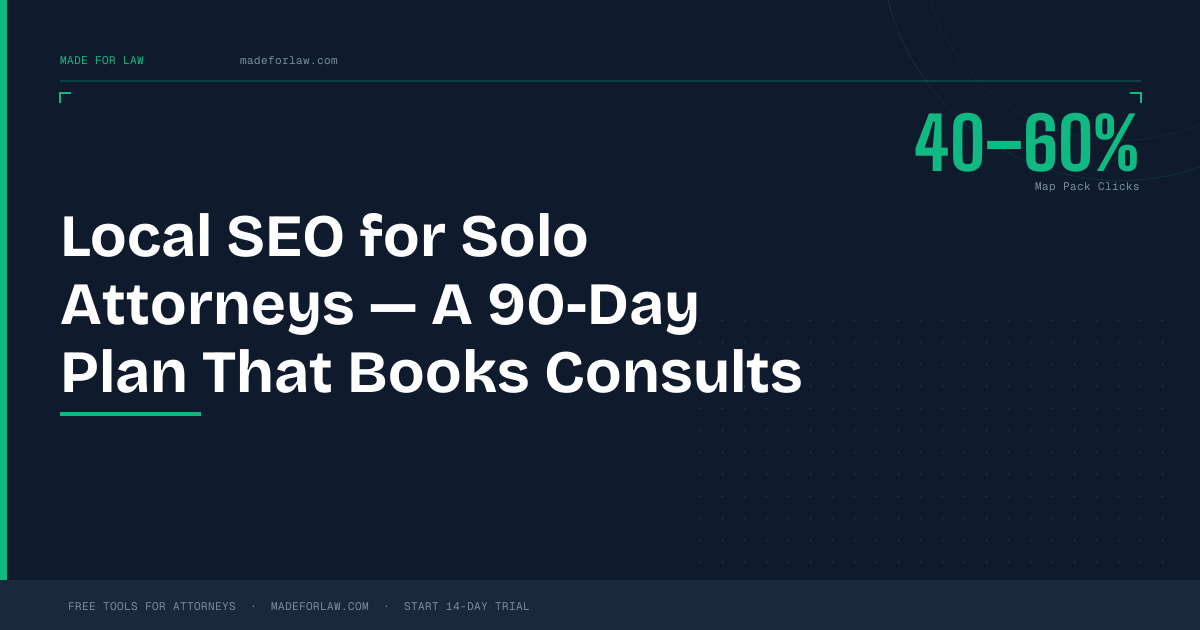
Does GBP actually help a small law firm get clients? Yes — for any firm taking local cases, the GBP listing usually outperforms every other free channel for visibility in search results. A dialed-in profile drives 40–60% of map-pack calls from potential clients searching "probate attorney near me" or "divorce lawyer [city]." If you optimize the 14 settings above, expect a meaningful lift in call volume within 60 days.
How often should I respond to reviews? Within 7 days, every single time, positive or negative. Google explicitly weights review-response rate in ranking, and prospects reading reviews care more about how you handled the negative ones than the positive reviews themselves. A consistent reply cadence is one of the cheapest local SEO wins available.
What's the right primary category for a probate attorney? Use Probate Attorney if it's available in your country (it's a real GBP category in the US). For estate planning practices, Estate Planning Attorney outranks the generic Lawyer category by 2–3x in our testing. Match your primary category to the specific search query you want to win, not the broad business name.
Disclaimer: This article is for general educational purposes only and does not constitute legal advice. Made For Law is not a law firm, and our team are not attorneys. We are not affiliated with any federal, state, county, or local government agency or court system. Content may be researched or drafted with AI assistance and is reviewed by our editorial team before publication. Laws change frequently — always verify information with official sources and consult a licensed attorney for advice specific to your situation. Full disclaimer
- Miami Gardens Discovery Websitemiamigardens.com
- CallRailcallrail.com

Our editorial team researches and summarizes publicly available legal information. We are not attorneys and do not provide legal advice. Every article is checked against current state statutes and official sources, but you should always consult a licensed attorney for guidance specific to your situation.