
Why local SEO is the main game for attorneys
Over 70% of legal search queries carry local intent — "probate attorney Cleveland," "divorce lawyer near me," "DUI defense Phoenix." For attorneys, local SEO isn't a sub-discipline of SEO; it is SEO. National-rank-for-everything strategies don't apply when your geographic service area is one county.
The mechanics are simpler than national SEO but the competition is sharper. Every local market has 10–50 firms fighting for the same map pack of three results. The firms that win do four things consistently — and most firms only do one or two of them.
This guide walks through the four pillars: Google Business Profile, on-page local SEO, citations and NAP hygiene, and reviews. Each pillar compounds with the others; doing one well lifts the others too. (See Google's LocalBusiness structured data documentation for the markup that powers all four.)
Pillar 1 — Google Business Profile (the foundation)
The local map pack is the most valuable real estate in local search, and Google Business Profile is the only way to appear in it. The detailed GBP playbook lives in the GBP guide, but the headline summary:
- Exact primary category — "Estate Planning Attorney," "Personal Injury Attorney," not generic "Attorney."
- 3–5 supporting categories.
- Service area covering every county you actually serve, not just your office county.
- Photos: 10+ real photos including exterior, interior, attorney headshots.
- Posts: 2–3 per month, dated, linking to blog or calculator content.
- Q&A: 10–15 questions populated by you.
- Reviews: 50+ at 4.5+ stars, with active response on every review.
GBP optimization typically delivers a 30–60% map-pack visibility lift within 90 days when the listing was previously bare-bones. It's the single highest-ROI work in local SEO.
Pillar 2 — On-page local SEO
GBP gets you into the map pack. On-page work gets you into the local organic results that sit just below it. Three patterns that move the needle for attorney sites:
1. Practice-area + location pages. A page for every meaningful practice/location combination. "Probate Attorney Cleveland Ohio." "Probate Attorney Cuyahoga County." "Probate Attorney Akron Ohio." Each page has unique content (not the same template repeated 50 times) — local statute references, local court names, local case examples (anonymized), and a calculator embed.
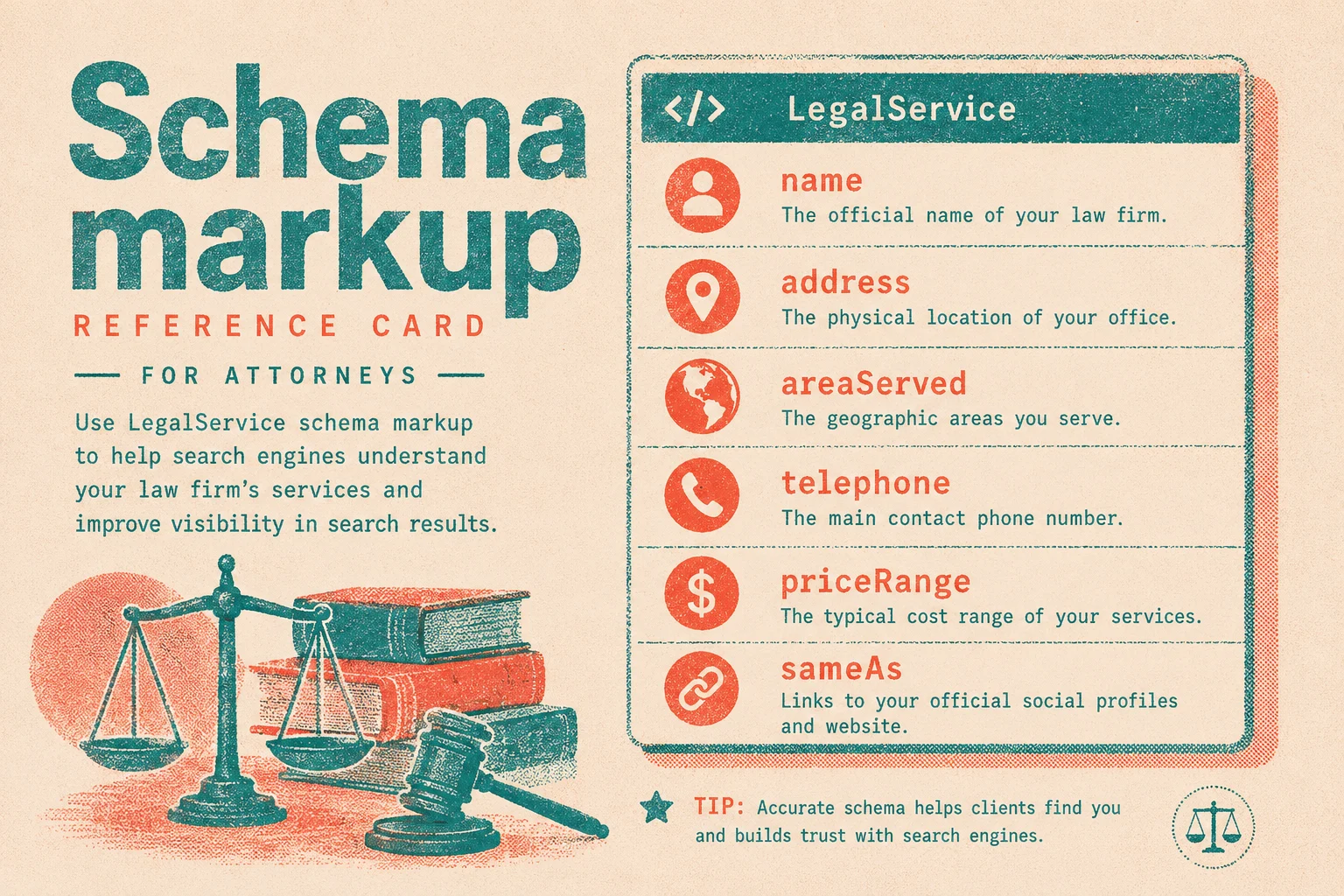
2. Schema markup. LegalService or Attorney schema with full NAP (Name, Address, Phone), service area, and aggregateRating from reviews. LocalBusiness schema for the office location. Don't ignore schema — Google uses it for AI overviews and rich snippets, and most attorney sites have none.
3. Title tags and headings. Title format: "[Practice Area] in [City] — [Firm Name]." H1 matches title. H2s cover local-intent subtopics: "How [practice area] works in [state]," "[State] [practice area] fees," "Why hire a [city] [practice area] attorney."
Content depth matters too — 1,500–2,500 words per practice/location page is the range that ranks consistently, but only when the content is genuinely local. A 2,000-word page with statute citations, court names, and county-specific data ranks; a 2,000-word page with ${city} swap-template content gets flagged as scaled content and demoted.
Pillar 3 — Citations and NAP hygiene
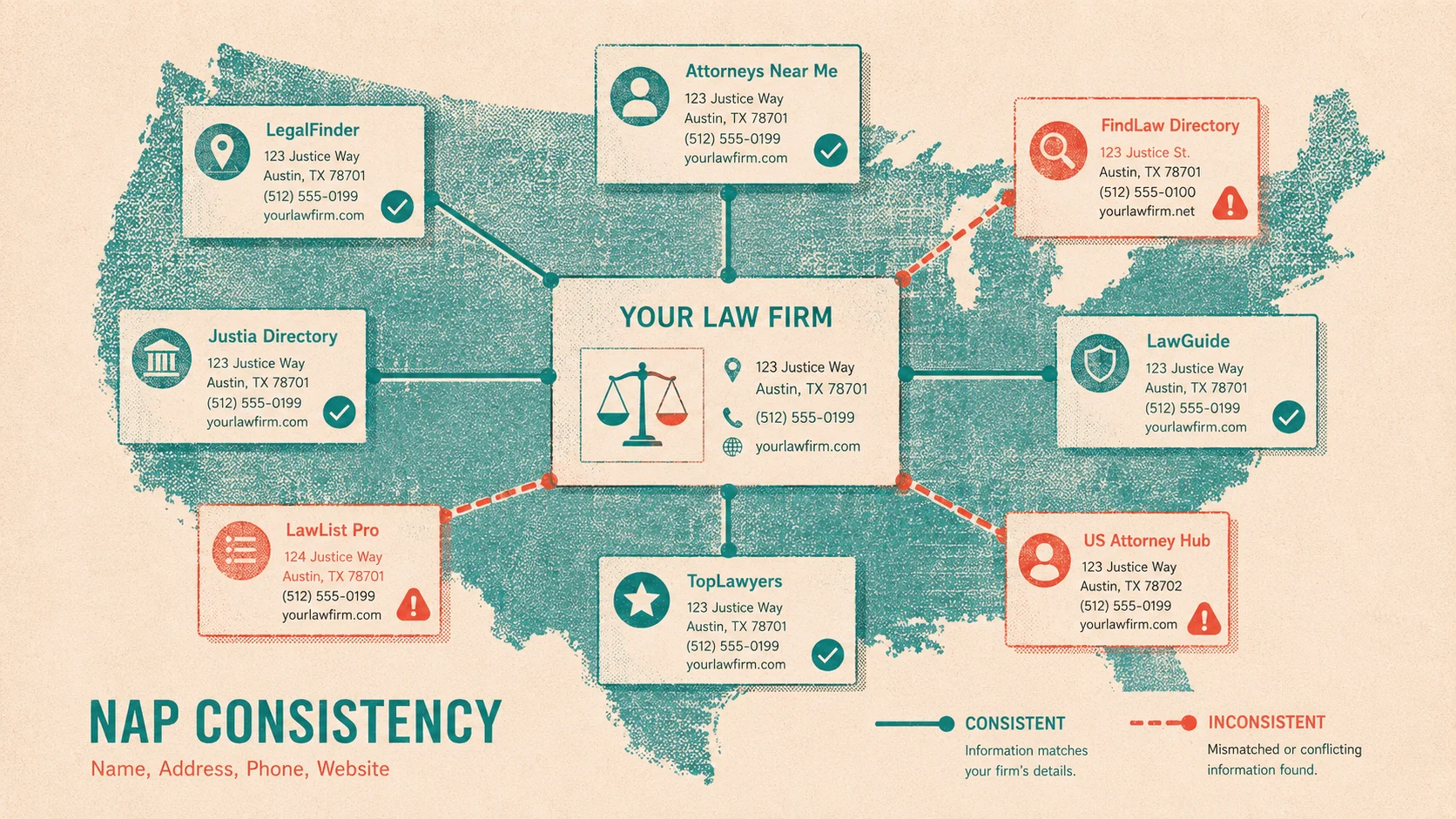
Citations are mentions of your firm name, address, and phone (NAP) across other websites — legal directories, bar association listings, local chamber of commerce, lawyers.com, Avvo, FindLaw, Justia. Google uses citation consistency as a ranking signal — if your NAP is identical across 50 directories, Google treats you as a verified local business. If your phone number varies, your address has typos, or your firm name shows different formats, Google penalizes the inconsistency.
Three citation rules:
- Pick one canonical NAP and use it everywhere. Down to the abbreviation ("Ste 200" vs "Suite 200" — pick one).
- Cover the top 30 legal directories. Avvo, FindLaw, Justia, Lawyers.com, Martindale-Hubbell, Super Lawyers, Best Lawyers, plus your state bar's lawyer-locator. Plus general business directories: Yelp, BBB, Yellow Pages, local chamber.
- Audit annually. Tools like Moz Local, BrightLocal, or Yext find inconsistencies. Fix them.
Don't pay for paid placements in directories unless you have specific ROI data — most legal directory paid placements have eroded over the last 5 years (see cost per lead benchmarks for current ranges). Free listings still help citation consistency.
Pillar 4 — Reviews (the prominence signal)
Reviews are the single biggest ranking factor in GBP, and they spill over into organic rankings too. Volume, velocity, and rating all matter. Three rules:
- 50+ reviews at 4.5+ stars is the target. Below 20 reviews, you're invisible in competitive markets. Above 100, you compound.
- Ask every closed client. Personalized email from the attorney, with the direct GBP review link. Response rates run 20–30% on personalized asks.
- Respond to every review. Positive ones get a 1–2 sentence thank-you. Negative ones get a measured, professional response that invites the reviewer to call. Never argue publicly.
Check your state bar's rules on review solicitation. Most states allow it with restrictions (no quotes, no fake reviews, no testimonials that imply guaranteed outcomes). California, Florida, Texas, and New York have the most detailed rules — read them before launching a review request system.
On-page SEO — title tags, meta descriptions, internal linking
Beyond local-specific work, the standard on-page SEO checklist still applies:
- Title tag with primary keyword + city. Under 60 characters.
- Meta description with secondary keyword + call to action. Under 160 characters.
- One H1 per page, matching the title intent.
- Internal linking from practice-area pages to calculators and FAQs. Every practice-area page should link to at least 3 related pages on the site.
- Image alt text describing the image accurately. Don't keyword-stuff alt text; describe what the image shows.
- Mobile-first design and fast load times (see bounce rate guide for Core Web Vitals targets).
Calculator-driven local SEO — the lift most firms miss
Calculator pages are an underused local SEO weapon. A "How much does probate cost in Ohio?" page with an embedded calculator and the state's statutory fee schedule ranks for "probate cost Ohio," "Ohio probate fees," "how much is probate Ohio," and a long tail of related queries.
Two reasons calculator pages outperform plain text pages on local-intent queries:
- Interactive content beats static guides by ~67% on engagement metrics (Outgrow 2024), which Google reads as relevance.
- Calculator pages answer the searcher's question directly, reducing bounce 30–50% vs static service pages — a positive ranking signal.
Made For Law's free probate calculator embeds in one line of code and ships with state-specific statute citations for all 50 states and DC — exactly the local-relevance signal Google rewards. The paid for-law-firms tier adds lead capture at the result step.
Tracking local SEO — what to measure
Four metrics monthly:
- Map-pack position for your top 5 local queries, tracked from a local IP (use BrightLocal or Local Falcon).
- Organic clicks from Google Search Console, filtered to queries containing your city or state.
- GBP Insights: search queries, direction requests, phone calls, website clicks.
- Lead-to-source attribution in your CRM — which channel drove each retained client. Local SEO usually shows up as a mix of "Organic — Google" and "Direct" (people who saw you on GBP and typed the firm name into the browser).
Timeline and budget expectations
Local SEO is the cheapest sustainable channel for attorneys but it's not fast. Realistic timeline:
- Months 1–3: GBP optimization + initial on-page work + citation cleanup. Map-pack visibility starts moving.
- Months 4–6: Reviews compound. Practice-area + location pages start ranking on long-tail queries.
- Months 7–12: Map-pack-3 achieved on primary practice/location combinations. Organic traffic starts converting.
- Months 13–18: CPLs trend toward $10–$40 range. Channel becomes the backbone of the firm's marketing.
Budget for execution (DIY): ~10 hours/month of attorney time for GBP posts, review responses, and content updates. Budget for an agency: $1,500–$4,000/month for a competent local SEO firm in legal. Skip the $500/month shops — they're usually doing nothing the firm couldn't do internally.
Common local SEO mistakes
Three patterns I see repeatedly:
- Treating GBP as a phonebook entry, not a marketing channel. Claimed but not optimized = lost ranking. Build the GBP out.
- Generic "Service Areas We Serve" pages with no unique content. A page that just lists 50 cities with ${city} swap-template content gets demoted as scaled content. Build 5–10 deep local pages instead.
- Hoping reviews come naturally. They don't. Build the request system in month 1.
Local SEO compounds. Start now and the firm that started 12 months ago will still be ahead of you next year — but every month you wait, the gap grows.
Local SEO ranking factors — what actually drives map-pack position
Local SEO ranking factors fall into four buckets, ordered by weight in Google's local algorithm:
- Google Business Profile signals (35–40%) — primary category, completeness, photos, posts, Q&A. The single biggest input into local search rankings.
- Reviews (25–30%) — count, average rating, recency, response rate. Volume and velocity matter together; an attorney with 80 reviews from the last 18 months beats one with 200 reviews from 5 years ago.
- On-page signals (15–20%) — title tags, headings, schema markup, NAP consistency on the site itself, internal linking from practice-area pages.
- Local backlinks and citations (15–20%) — local newspaper mentions, bar association directories, local chamber listings, lawyers.com / Avvo / Justia profiles.
Solo and small law firm SEO has tighter leverage on the first three than the fourth. Local backlinks help, but a personal injury attorney or criminal defense lawyer who obsesses over backlink count while neglecting reviews is optimizing the wrong axis. Start with the GBP and review systems; build local backlinks as a slower secondary track.
Implementing local SEO — a 90-day execution plan
Here's what implementing local SEO actually looks like as a small law firm. Not strategy slides — the calendar.
Month 1 — foundation. Claim and optimize the Google Business Profile (categories, hours, photos, services). Audit NAP consistency across the top 30 legal directories using a tool like Moz Local or BrightLocal. Fix the typos and inconsistencies that have been there for years. Add LegalService + LocalBusiness schema to the homepage and primary practice-area pages.
Month 2 — content depth. Build (or rebuild) the primary practice/location page to 1,500–2,500 words with statute citations, court names, and county-specific data. Build the calculator-driven cost page. Write the first long-form FAQ blog post. Internal links across all three.
Month 3 — reviews and posts. Launch the post-matter review-request workflow. Personal email from the attorney to every recently-closed client (where state bar rules allow). Start the GBP post cadence — 2–3 per month, dated, linking to your content. Begin monthly tracking of map-pack position for your top 5 local queries.
By month 4, the GBP signals start moving and the on-page work compounds. Most small law firm local SEO efforts that fail, fail because they stop at month 2 — the firm gets impatient with the timeline and pivots to paid ads or a new agency. Stick the landing on the 90-day plan and the rest of the year compounds.
Local SEO services — DIY, in-house, or agency?
Three options for getting local SEO services done, with honest tradeoffs on each.
DIY. Best for solo attorneys with 5–10 hours a month to dedicate to marketing. The GBP and review work can be done by the attorney directly, faster than briefing an agency. On-page content depth is hard to outsource for legal — the attorney's firsthand expertise is what makes the page rank. DIY breakeven point: most solo practices through the first 12–18 months.
In-house marketing hire. Best for 3–8 attorney firms with the budget for a full or part-time marketer. Total comp $60–100K plus tools. The hire handles execution; the attorney provides the expertise and approves content. Works well when the firm has consistent monthly marketing work to feed the role.
Agency. Best for firms that want to delegate execution entirely. The market splits into two tiers — competent legal-specialist SEO services agencies at $1,500–$4,000/month who genuinely move rankings, and the $500/month shops that do little more than autopilot directory submissions. The cheap shops produce no measurable lift; the competent ones do. Ask for case studies with specific map-pack movement and CPL numbers before signing.
Whatever option you pick, the work itself doesn't change. Google's local algorithm cares about the same signals whether the firm executes them or an agency does. The choice is about who's accountable for getting them done.
Local backlinks — what actually helps a law firm rank
Local backlinks help local SEO rankings, but the kind that move the needle are narrower than most SEO content suggests. Three categories of local backlinks that genuinely help a law firm:
- State and county bar directories — your state bar's lawyer-locator, the county bar's referral directory. These are authoritative, locally relevant, and often the only directory link a small law firm needs.
- Local civic and chamber listings — local chamber of commerce, local community foundation, local nonprofit boards you serve on. Sponsoring a community event or 5K usually earns a sponsor-page backlink that doubles as a local relevance signal.
- Local news mentions — appearing in the local paper as an expert source (HARO-style queries) or as a sponsor of a community event. Even small-town papers carry strong local authority for Google's geo signals.
What doesn't help much at the small law firm scale: bought guest posts on "SEO blog networks," PBN links, mass-scale directory submission services. Most of these are either neutral or actively penalized; the time spent chasing them dilutes the local SEO efforts that actually compound.
Dominate local search with local citations and local business directories
To dominate local search in a competitive metro, citation depth matters as much as citation accuracy. The goal isn't just NAP consistency — it's appearing across enough local business directories that Google and other search engines read the firm as locally established.
Three layers of local citations to build, in order:
- Tier 1: Legal-specific directories. Avvo, FindLaw, Justia, Lawyers.com, Martindale-Hubbell, Super Lawyers, your state bar's lawyer-locator. These carry the most local SEO weight per citation because Google treats legal directories as authoritative for legal-services intent.
- Tier 2: General local business directories. Yelp, BBB, Yellow Pages, local chamber of commerce, local Better Business Bureau. Each adds NAP reinforcement and broadens the citation footprint.
- Tier 3: Hyper-local directories. City-specific business directories, neighborhood association listings, local nonprofit sponsor pages. These are slow to find but each one tells search engines that the firm is genuinely part of the local audience.
Implementing local SEO citation-building is a one-time effort with a long tail. A small law firm that builds 30–50 consistent citations in the first 3 months locks in a local SEO foundation that compounds for years. The visibility in local search results that follows is what most agencies sell as local seo services — but the work is straightforward enough that solo and small law firms can do it themselves.
Local SEO strategies for client reviews and local keyword targeting
Beyond citations, two local SEO strategies separate the firms that rank from the firms that don't: a deliberate local keyword targeting plan, and a client reviews workflow.
Local keyword targeting. Build a single local keyword spreadsheet that maps your practice/location combinations to specific search queries. Each row is a target — "probate lawyer Cleveland Ohio," "Cleveland probate cost," "Cuyahoga County estate planning" — and each row gets one dedicated page on the website. The page's title tag, H1, meta description, and first paragraph all reference the local keyword in natural language. No keyword stuffing — Google's algorithm punishes it. Rank higher in local search results by giving each local keyword its own dedicated page, not a swap-template wall.
Client reviews workflow. Every closed matter triggers a personal email from the lawyer to the client with a direct link to the GBP review page. Track response rate in a simple spreadsheet (matter closed date / review request sent / review received). A 20–30% response rate from personalized asks compounds rapidly: 10 closed matters a month = 2–3 new reviews/month = 30+ reviews/year. That cadence outpaces 80% of local competitors and feeds local search rankings consistently.
Together, local keyword targeting and client reviews are how a small firm climbs from invisible to ranking in 6–9 months. Local SEO can help every practice area — corporate law, family law, criminal defense, estate planning — but the local seo tactics that win are the same across verticals. Improve your local SEO consistently and the SEO strategy compounds.
Common local SEO questions — short answers
A few questions that come up in every guide to local SEO conversation with lawyers:
- How long does it take to appear in local search results for a law firm? 3 months to see movement on the local pack, 6–9 months to land in map-pack-3 on primary queries, 12–18 months for the channel to mature into a primary lead source. Local search engine optimization rewards consistency more than aggression.
- Do search engine optimization tactics from 2018 still work? Most of the fundamentals do — local citations, on-page SEO, schema markup, client reviews. What's changed: scaled-template content, link-buying, and keyword-stuffed local pages are now actively penalized. Quality and depth win over volume.
- How do local clients actually find lawyers in 2026? Roughly: 40% Google map pack, 30% organic search results, 15% direct/brand, 10% paid ads, 5% other. Local SEO targets the first 70% of that mix — the largest channel by a wide margin. Improve your local SEO and you improve the largest single channel in the funnel.
- Should I improve local SEO before paid ads? Yes, in almost every case. Paid ads run $80–$300+ CPLs in competitive legal verticals; local SEO compounds to $10–$40 CPLs over 12–18 months. Build the durable channel first, then layer paid ads as a faucet — never as the primary plumbing.
Implementing local SEO is the cheapest sustainable channel in legal marketing. It rewards firms that show up consistently for a year or more — and punishes the ones who treat it as a 90-day test. The potential client searching tonight will see whichever firm has built local search visibility over the prior 12 months; the firm that started 12 months ago wins, the firm that hasn't started yet won't.
Encouraging satisfied clients to leave reviews — without crossing the line
Encouraging satisfied clients to leave reviews is the single biggest legal local SEO lever, and it's also the area where state bar rules are most specific. Most states permit review requests with restrictions; a handful (California, Florida, Texas, New York) have detailed rules attorneys must follow.
Three rules that keep review requests inside the lines of every state's ethical guidelines:
- No quote pulls without consent. You cannot pull a phrase from a client's review and use it as a testimonial on your website without explicit written permission.
- No guarantees of outcome. Don't quote, suggest, or imply that a review establishes a guaranteed result for future clients.
- No pay-for-reviews. Don't offer discounts, fee reductions, or any value in exchange for a review. Google bans this; bar rules in most states ban it too.
Legitimate post-matter review requests are workable in every state. A short, personal email from the attorney — "If our work was helpful, a quick Google review would mean a lot" — sent the week after a matter closes, with the direct link to your GBP review page. Response rates run 20–30% on personalized asks vs 2–5% on automated CRM blasts.
Over 12–18 months, this single workflow produces the volume, velocity, and rating signals that dominate local SEO rankings — outweighing on-page, citations, and backlinks combined.
Disclaimer: This article is for general educational purposes only and does not constitute legal advice. Made For Law is not a law firm, and our team are not attorneys. We are not affiliated with any federal, state, county, or local government agency or court system. Content may be researched or drafted with AI assistance and is reviewed by our editorial team before publication. Laws change frequently — always verify information with official sources and consult a licensed attorney for advice specific to your situation. Full disclaimer
- Google's LocalBusiness structured data documentationdevelopers.google.com

Alex Tarlescu is co-founder of Made For Law — the SaaS platform that gives attorneys embeddable legal calculators with built-in lead capture. He's also co-founder of Good Smart Idea, the sister marketing agency that handles broader marketing engagements for law firms. Based in Cleveland with nearly 20 years of experience in sales, digital marketing, and AI automation, he writes about marketing — not legal advice — and the systems that turn website visitors into signed clients.