
If You're In Immediate Danger Right Now
Call `911` for immediate police response.
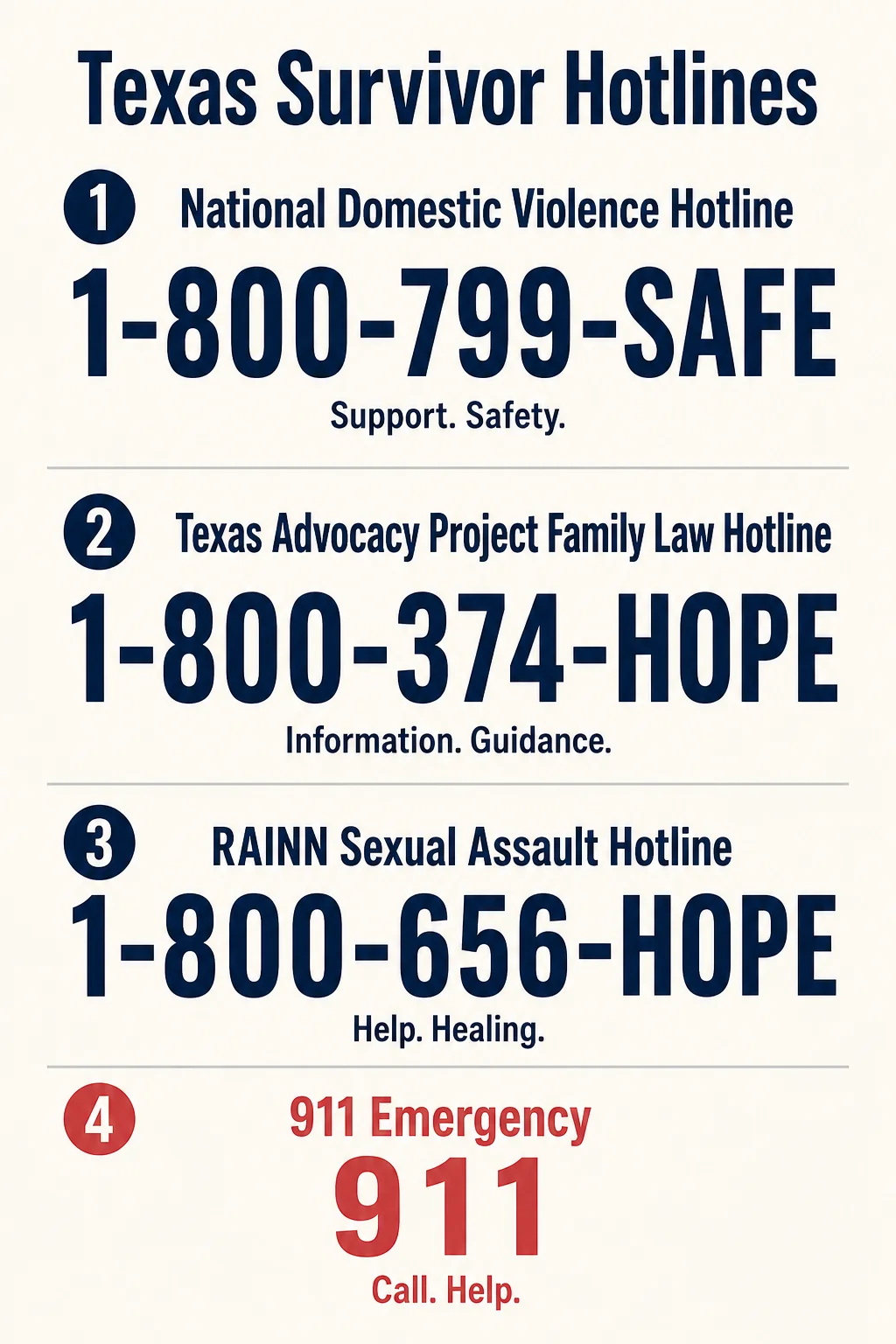
Call the National Domestic Violence Hotline at `1-800-799-SAFE` (7233) for crisis support, safety planning, and referrals to local Texas shelters.
Call the Texas Advocacy Project Family Law Hotline at `1-800-374-HOPE` (4673) for free legal advice and protective order assistance, Spanish-speaking advocates available.
Call `1-800-656-HOPE` (RAINN) for sexual assault crisis support.
Find a local shelter through the TCFV statewide directory — 78 accredited family violence centers across Texas.
Free Protective Orders — Who Qualifies in Texas
Texas defines family violence broadly. Under Family Code §71.004, it covers acts by a family member, household member, or someone in a dating relationship — physical harm, bodily injury, assault, sexual assault, or a threat that reasonably places the person in fear of imminent physical harm. Texas added dating relationships in 1995, so survivors don't need to be married or living with the abuser to qualify.
Who can apply for a protective order under Family Code §82.002: the adult survivor, a prosecuting attorney on the survivor's behalf, the Texas Department of Family and Protective Services in a case involving a child, or a guardian. The application is filed in the county where the survivor lives, the abuser lives, or where the violence occurred.
Here's the short answer — if you're a survivor of family violence, sexual assault, stalking, or human trafficking, you can apply for a protective order. The court fee is `$0` under §81.001. Spanish translation is available at every Texas court intake desk.
Emergency Protective Orders — Issued at the Arrest
An Emergency Protective Order — EPO — is the first line of legal protection. Under Texas CCP Article 17.292, the magistrate at an abuser's arrest can issue an EPO without a hearing if family violence, sexual assault, stalking, or human trafficking is involved. The EPO is issued to the magistrate-issued — no application from the survivor is required.
EPO duration: 31–91 days. If the offense involved a deadly weapon or serious bodily injury, the EPO automatically extends to 61–91 days. EPOs are filed in the local court records and entered into the Texas Crime Information Center (TCIC) and NCIC databases, so any law enforcement officer anywhere in Texas can see and enforce the order at a traffic stop or domestic call.
The EPO is the bridge. It buys the survivor 1–3 months of legal protection while preparing to file the longer-term protective order under Family Code Title 4.
Permanent Protective Orders Under Family Code §85.022 and §85.025
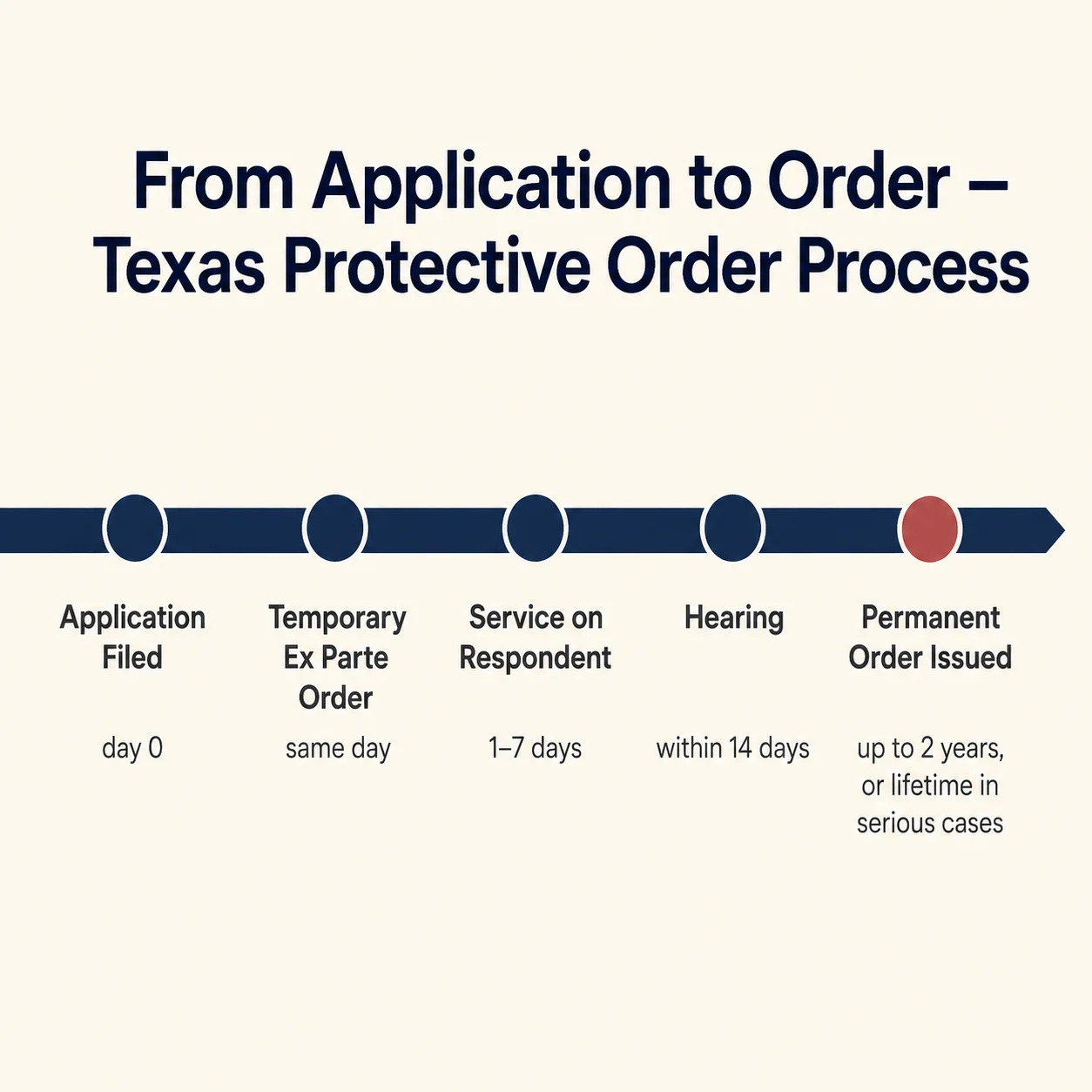
The standard Texas protective order — issued after a hearing — lasts up to `2 years` under Family Code §85.025. For cases involving serious bodily injury, sexual assault, a felony offense against the survivor, or a violation of a previous protective order, the court can issue a lifetime protective order.
What the protective order can do, per Family Code §85.022: prohibit the abuser from going near the survivor, the survivor's residence, workplace, or children's school; prohibit communication; require completion of a battering intervention and prevention program; suspend a firearms license; require child support; require kick-out of the residence (vacate order). The kick-out provision is powerful — it requires the abuser to leave the shared home regardless of whose name is on the lease or deed.
Texas protective orders carry teeth. Violating a protective order is a Class A misdemeanor under Penal Code §25.07, and a second offense or any violation involving assault is a third-degree felony. Federal law layers on top — under 18 U.S.C. §922(g)(8), a person subject to a qualifying protective order can't legally possess a firearm.
How to File Pro Se — Step by Step
Most Texas survivors file for a protective order pro se — without an attorney — using TexasLawHelp.org's Protective Orders Toolkit. The toolkit walks through the application, the affidavit, and the proposed order in plain language. Spanish translations are available.
Step 1 — gather evidence. Police reports, medical records, photographs of injuries, text messages, voicemails, witness statements. The court hearing for a protective order is evidentiary; the more documentation, the stronger the application.
Step 2 — file the application. Bring the completed forms to the district or county clerk's office in the appropriate Texas county. The clerk waives the filing fee under §81.001 for family violence cases. The court usually issues a Temporary Ex Parte Protective Order on the same day, providing immediate protection for up to 20 days until the full hearing.
Step 3 — service. The county sheriff or constable serves the abuser with notice of the application and the hearing date. Service is free for protective order applications. The hearing must be held within 14 days of the application under Family Code §84.001.
Step 4 — attend the hearing. Bring all evidence. The judge applies a preponderance standard — more likely than not that family violence occurred and is likely to occur again. If granted, the protective order is entered into the statewide and national databases and provided to the survivor in writing.
Free Legal Aid — Texas Hotlines and Organizations
The Texas Advocacy Project is the single best statewide resource. The Family Law Hotline at `1-800-374-HOPE` (4673) provides free legal advice to survivors of domestic violence, sexual assault, stalking, and human trafficking statewide. Spanish-speaking advocates are available. Texas Advocacy Project handles ~30,000 survivor contacts per year and provides direct legal representation in many cases.
TexasLawHelp.org is the statewide legal information site operated by the Texas Legal Services Center — free protective order forms, divorce forms (including the filing for divorce after family violence guide), child custody forms, and step-by-step Spanish translations.
Texas Council on Family Violence (TCFV) operates a statewide directory of family violence programs — 78 accredited family violence centers across Texas, each offering shelter, legal advocacy, and counseling. Most centers staff a domestic violence legal advocate who can help survivors complete protective order applications and accompany them to hearings.
National Domestic Violence Hotline — `1-800-799-SAFE` (7233) — provides crisis support, safety planning, and referrals to local Texas resources 24/7. The hotline is operated out of Austin and serves the entire US.
Legal Aid Organizations Across Texas — Where to Find Free Civil Legal Help
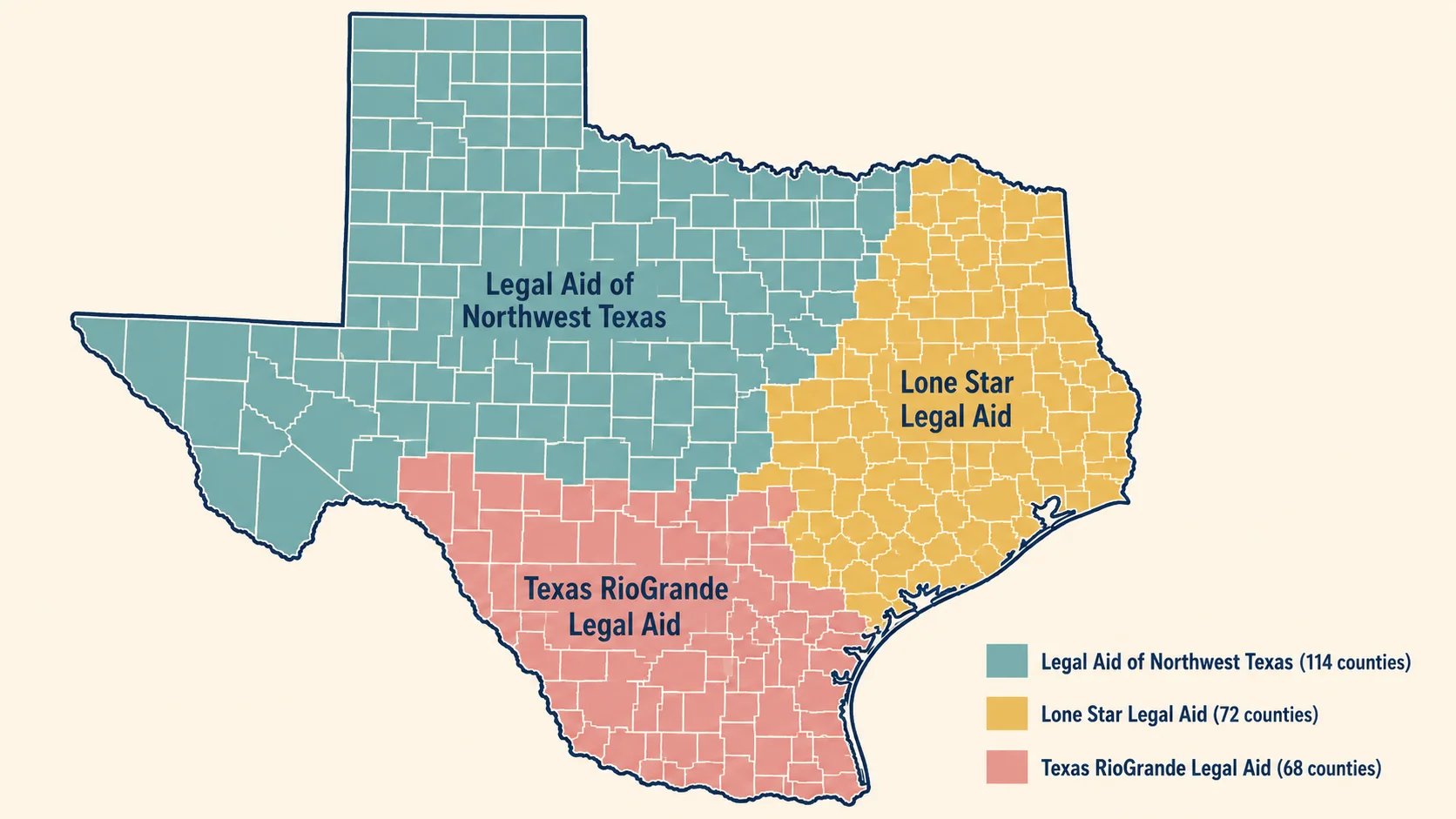
Texans seeking free legal help in family violence cases have several major legal aid organizations to call. Legal Aid of Northwest Texas covers 114 Texas counties across north and west Texas (Dallas, Fort Worth, Lubbock, Amarillo, Wichita Falls, Abilene) with civil legal services for low-income Texans — including survivors of domestic abuse and victims of domestic violence. Legal Aid of Northwest Texas runs a dedicated legal aid line for intake calls. Lone Star Legal Aid covers 72 counties across southeast and east Texas (Houston, Beaumont, Tyler). Texas RioGrande Legal Aid (TRLA) serves the southern 68 counties (San Antonio, Austin, McAllen, El Paso). Together these three legal aid organizations cover all 254 Texas counties.
Each handles civil legal matters that include domestic violence cases, divorce or child custody, protective orders, custody and support, mediation referrals, child abuse cases (representing the protective parent), and immigration legal services for crime victims. All three accept walk-in intake, phone intake, and online applications; they prioritize family violence cases and can usually schedule a same-week legal hotline consultation. Each provides legal information and legal assistance to pro se litigants who file for protective orders or divorce without a private attorney. They protect the legal rights of survivors of domestic violence in family court proceedings, custody and support cases, and any other legal issue that touches the justice system.
Beyond the big three, Volunteer Legal Services of Central Texas supplies volunteer attorneys for pro bono case handling. Several Texas law schools — University of Texas School of Law, University of Houston Law Center, SMU Dedman School of Law, Baylor Law — run domestic violence clinics; a law student under faculty supervision can prep your protective order. AVDA attorneys (Aid to Victims of Domestic Abuse, Houston) handle a high volume of Harris County family violence cases. Texas's network of 78 family violence centers, listed at TCFV's program directory, each staff a legal advocate to help survivors access the justice system and connect to broader legal support.
Veterans and their families have an additional layer of free legal support through the Texas Lawyers for Texas Veterans network — pro bono attorneys statewide for family law and protective order matters. Equal access to justice is the explicit mission of the Texas legal aid network — and the work focuses on the legal hotline triage that funnels Texans to the right aid organizations, plus direct representation in court when capacity allows. The goal across the network is to end domestic violence in Texas by removing the legal cost barrier for survivors. Civil legal services are also coordinated for victims of violent crime through the Texas Office of the Attorney General's Crime Victims' Compensation program.
County-Level Resources — Travis, Harris, Dallas, Tarrant
Travis County (Austin) — the Family Violence Protection Team inside the County Attorney's office files protective orders on behalf of survivors at no cost. Survivors don't need to file pro se; the County Attorney becomes the applicant.
Harris County (Houston) — the Harris County DA Family Criminal Law Division prosecutes family violence cases and works with AVDA (Aid to Victims of Domestic Abuse) and the Houston Area Women's Center on protective order applications.
Dallas County — the Dallas County DA Family Violence Division prosecutes family violence cases. Mosaic Family Services serves immigrant and refugee survivors with multilingual advocates.
Tarrant County (Fort Worth) — SafeHaven of Tarrant County provides shelter, legal advocacy, and protective order assistance.

Custody and Divorce After Domestic Violence
Family violence isn't just relevant to the protective order — it's a heavily weighted factor in any subsequent Texas divorce or custody case. Under Texas Family Code §153.004, the court must consider any history of family violence when deciding conservatorship (Texas custody) and possession (Texas visitation). A documented history creates a rebuttable presumption against joint managing conservatorship and supervised visitation requirements.
Divorce filing fees in Texas typically run $300–$400 depending on the county. Survivors who can't afford the fee can file an Affidavit of Indigency, and the court will waive it. Our Texas divorce cost estimator walks through full cost ranges. Many family violence survivors use a TexasLawHelp.org expedited divorce after family violence packet — Texas allows divorce in family-violence cases without the standard 60-day waiting period.
Child support orders can be included in the protective order itself under §85.022 — so a survivor doesn't have to file a separate Suit Affecting the Parent-Child Relationship just to get support flowing. That matters when an abuser controls the household finances.

Immigrant Survivors — VAWA Self-Petition and U-Visa
Immigrant survivors of family violence may qualify for immigration relief independent of an abusive US-citizen or LPR spouse. The Violence Against Women Act self-petition under USCIS Form I-360 lets an abused spouse, child, or parent of a US citizen or LPR petition for lawful permanent residence without the abuser's knowledge or consent. The petition is confidential — USCIS won't notify the abuser.
The U-Visa is available to victims of certain crimes — including domestic violence, sexual assault, and human trafficking — who have suffered substantial physical or mental abuse and are helpful to law enforcement. The U-Visa caps at 10,000 per year and has a multi-year backlog, but it provides work authorization and a path to a green card.
Immigrant survivors should contact a nonprofit with VAWA and U-Visa experience — Tahirih Justice Center, Mosaic Family Services, and American Gateways all serve Texas survivors. The Violence Against Women Act DOJ overview describes the full federal protections.
Disclaimer
Made For Law is not a law firm and does not provide legal advice. We're an editorial team and software provider, not affiliated with any government entity, court, or legal aid organization. This article describes general practice under Texas family law and federal immigration relief as of 2026; statutes and procedures change. If you're a survivor of family violence, sexual assault, or stalking, contact a licensed Texas family law attorney, a TCFV-accredited family violence center, or the Texas Advocacy Project hotline at 1-800-374-HOPE for guidance specific to your situation.
Disclaimer: This article is for general educational purposes only and does not constitute legal advice. Made For Law is not a law firm, and our team are not attorneys. We are not affiliated with any federal, state, county, or local government agency or court system. Content may be researched or drafted with AI assistance and is reviewed by our editorial team before publication. Laws change frequently — always verify information with official sources and consult a licensed attorney for advice specific to your situation. Full disclaimer
- RAINNrainn.org
- TCFV statewide directorytcfv.org
- Family Code §71.004statutes.capitol.texas.gov
- Family Code §82.002statutes.capitol.texas.gov
- Texas CCP Article 17.292statutes.capitol.texas.gov
- Family Code §85.025statutes.capitol.texas.gov
- Family Code §85.022statutes.capitol.texas.gov
- Penal Code §25.07statutes.capitol.texas.gov
- 18 U.S.C. §922(g)(8)law.cornell.edu
- TexasLawHelp.org's Protective Orders Toolkittexaslawhelp.org
- Family Code §84.001statutes.capitol.texas.gov
- Texas Advocacy Projecttexasadvocacyproject.org
- TexasLawHelp.orgtexaslawhelp.org
- filing for divorce after family violence guidetexaslawhelp.org
- Texas Council on Family Violence (TCFV)tcfv.org
- National Domestic Violence Hotlinethehotline.org
- Legal Aid of Northwest Texaslanwt.org
- Lone Star Legal Aidlonestarlegal.org
- Texas RioGrande Legal Aid (TRLA)trla.org
- Volunteer Legal Services of Central Texasvolunteerlegalservices.org
- AVDA attorneysavda-tx.org
- Texas Lawyers for Texas Veteranstexasbar.com
- Crime Victims' Compensation programtexasattorneygeneral.gov
- Family Violence Protection Teamtraviscountytx.gov
- Harris County DA Family Criminal Law Divisionapp.dao.hctx.net
- Dallas County DA Family Violence Divisiondallascounty.org
- Mosaic Family Servicesmosaicservices.org
- SafeHaven of Tarrant Countysafehaventc.org
- Texas Family Code §153.004statutes.capitol.texas.gov
- USCIS Form I-360uscis.gov
- U-Visauscis.gov
- Tahirih Justice Centertahirih.org
- American Gatewaysamericangateways.org
- Violence Against Women Act DOJ overviewjustice.gov

Our editorial team researches and summarizes publicly available legal information. We are not attorneys and do not provide legal advice. Every article is checked against current state statutes and official sources, but you should always consult a licensed attorney for guidance specific to your situation.