

Solo attorney SEO isn't BigLaw SEO at smaller scale
Most SEO advice for attorneys is written for 50-lawyer firms with marketing departments and $200K+ annual SEO budgets. None of that applies to a solo practice. The leverage points are different, the time budget is different, the competitive set is different.
Solo attorneys win SEO with three things: narrowness, depth, and patience. Pick one practice area. Pick one geography (or a tight cluster of counties). Build 5–10 pages that are genuinely the best resource in that narrow slot. Compound for 12–18 months.
That's the whole playbook. The rest of this guide is how to execute it without burning more than 10 hours a month on marketing work — because if SEO requires more time than that, it's not a solo strategy, it's a part-time second job.
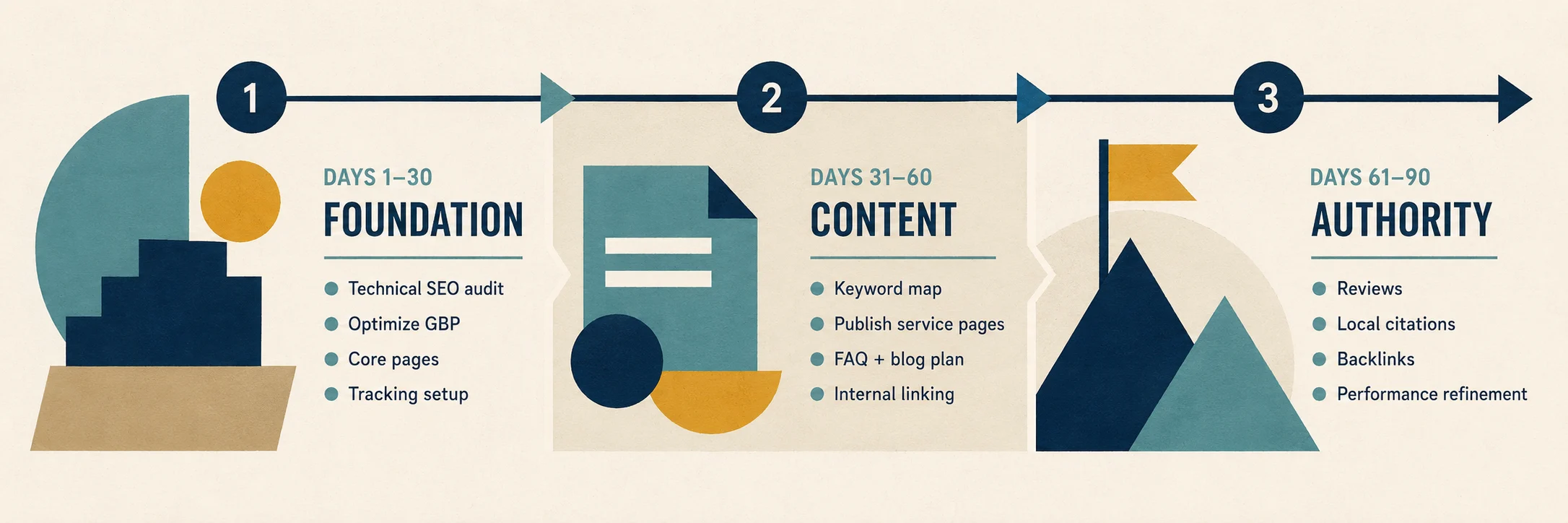
The narrowness rule — why solo SEO wins on focus
A solo probate attorney trying to rank for "probate attorney Ohio" statewide is competing with 80+ firms with bigger sites, more reviews, and more backlinks. That fight is unwinnable in year one and barely winnable in year three.
The same attorney targeting "probate attorney Cuyahoga County" or "Cleveland probate cost calculator" is competing with 5–8 firms, most of which have weak GBP profiles and shallow content. That fight is winnable in 6–12 months.
Multiply that across 5–8 local micro-targets — "Cleveland probate," "Cuyahoga County probate," "Ohio probate cost," "Ohio executor fees," "Ohio small estate affidavit," etc. — and the cumulative traffic exceeds the statewide top-5 result by month 18. Narrow and deep beats broad and shallow at solo scale every time.
The 5-page minimum that does 80% of the work
Most solo attorney sites have 20–40 pages and rank for none of them. The fix isn't more pages — it's making 5 pages excellent. Here's the priority order:
1. Home page. Headline that names the practice area + service area in plain English. Calculator embed above the fold (or a clear link to it). One CTA: book a 15-minute consult. Phone number prominent. Testimonials if available (real, not fabricated). Trust signals — bar admission, years of experience, key cases (anonymized).
2. Primary practice/location page. "Probate Attorney in Cleveland Ohio" or whatever your narrow slot is. 1,500–2,500 words. Cover what you do, who you serve, how much it costs, how long it takes, what the process looks like, and why someone needs an attorney for it. Internal links to your calculator and FAQ. Schema markup (LegalService + LocalBusiness + Person).
3. Calculator-driven cost page. "How much does probate cost in Ohio?" with an embedded calculator. This is the highest-converting page on the site and one of the easiest to rank for. Made For Law's free probate calculator embeds in one line; the paid for-law-firms tier adds lead capture.
4. Top FAQ blog post. Pick the single most-asked question in your practice — "Do I need an attorney for probate?", "How long does probate take in Ohio?", "What is a small estate affidavit?" — and write a definitive 1,000–1,800 word answer with statute citations. This is your authority anchor.
5. Optimized Google Business Profile. Not a page per se, but the 5th leverage point. See the GBP guide for the full playbook.
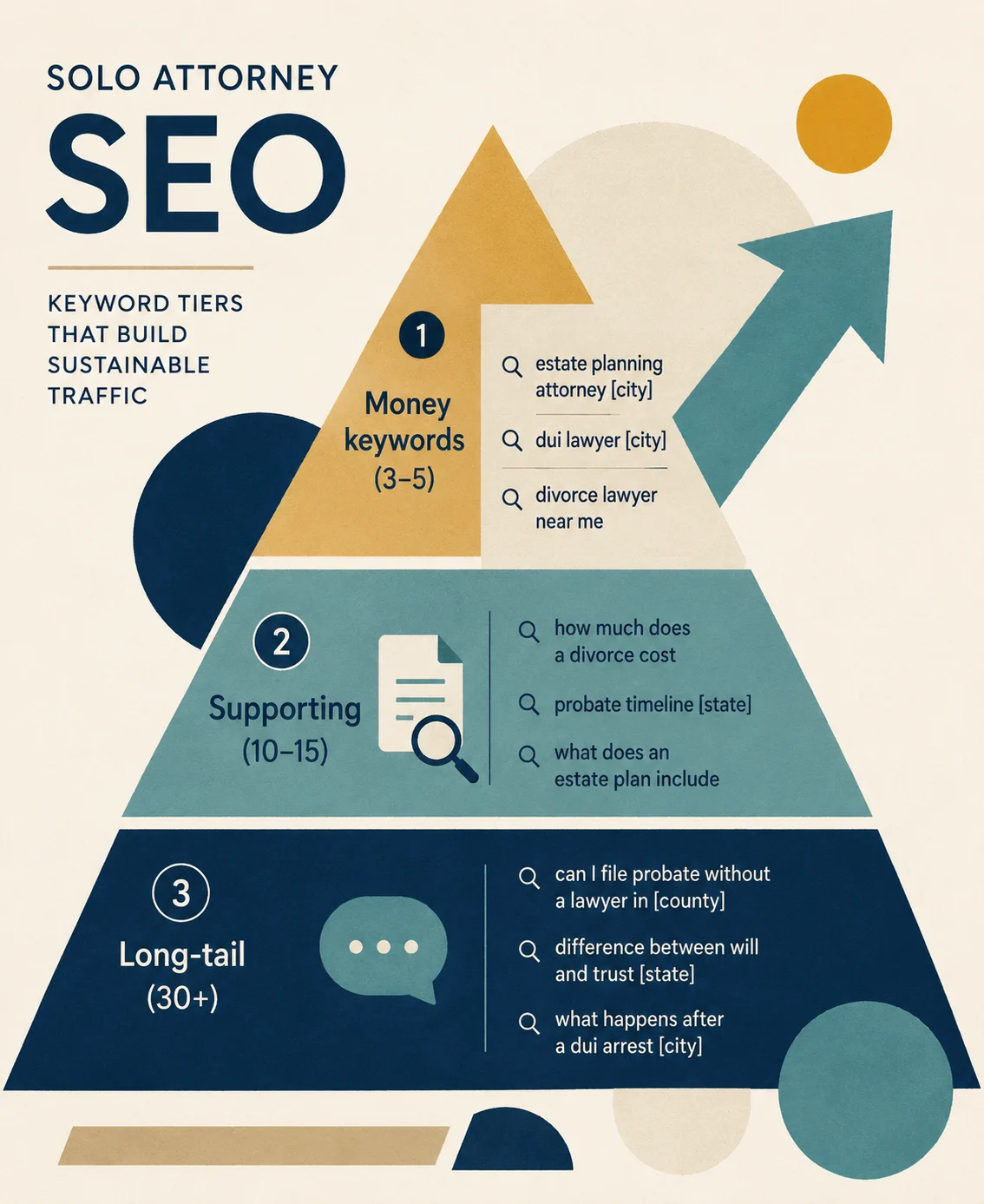
Content depth vs content volume
Solo attorneys consistently underweight depth and overweight volume. They publish 20 thin blog posts and rank for none of them. The fix is to delete or consolidate the thin posts into 3–5 deep ones.
Depth specifics:
- 1,500–2,500 words per page on practice/location pages and pillar FAQ posts.
- Statute citations and court names — "Ohio Revised Code §2113.35 sets the executor fee schedule" signals topical authority to Google.
- Real numbers — fee ranges, timelines, thresholds — not generic "varies by state."
- Internal links between related pages — every practice-area page should link to at least 3 related pages on the site.
Google's helpful content guidance rewards depth and demotes thin content. A solo site with 8 deep pages will outrank a competitor's 40 shallow ones consistently.
Local SEO is the main game
For solo attorneys, local SEO carries 70–80% of the SEO win. The detailed playbook is in the local SEO guide, but the headline framework:
- GBP optimization drives map-pack visibility (44% of local-search clicks).
- Practice-area + location pages drive local organic rankings.
- Citations across legal directories and local business listings reinforce the local signal.
- Reviews compound for ranking and conversion.
Do these four things and the rest of "SEO" is mostly optional at the solo scale.
What about backlinks?
Backlinks matter for SEO, but they matter much less at the solo scale than the SEO industry would have you believe. Three reasons:
1. Local intent queries reward proximity and prominence over link equity. A solo firm with 80 reviews and a clean GBP outranks a competitor with twice the backlinks but a weaker local signal on local searches.
2. Most backlink tactics — guest posting, broken-link building, scholarship pages — burn enormous time for small payoff at solo scale.
3. The backlinks that do matter for attorneys are mostly free and earned organically — state bar directory, local chamber of commerce, lawyers.com / Avvo / Justia profiles, partnerships with local CPAs and financial planners who link to you from their websites.
Don't spend $500–$5K/month on a "link building" service. The same budget on review acquisition, GBP optimization, and content depth delivers 3–5x the ranking lift at the solo scale.

Time budget — what 10 hours a month gets you
Solo attorneys have ~10 hours a month for marketing without it cannibalizing billable work. Here's how to spend it for SEO:
- 2 hours/month: Write or refresh one blog post (1,500+ words on a high-intent FAQ topic).
- 2 hours/month: Update GBP — post, refresh photos, respond to reviews.
- 2 hours/month: Review-acquisition outreach — personal emails to recently-closed clients asking for GBP reviews.
- 2 hours/month: Citation hygiene + on-page SEO audit (Search Console review, fix broken links, update title tags).
- 2 hours/month: Referral partner maintenance — quarterly check-ins with CPAs, planners, partner attorneys.
That's the recipe. Stick to it for 12–18 months and the channel pays for itself many times over.
Tracking — what to measure
Four metrics monthly:
- Map-pack position for your top 5 local queries (Local Falcon, BrightLocal, or manual check from a local IP).
- Organic clicks from Google Search Console.
- Calculator and form completions from your CRM or analytics.
- Retained-client source attribution — where did each new client first hear about you?
Avoid vanity metrics. Total organic traffic, total pageviews, total impressions — none of these correlate well with retained clients at the solo scale. Map-pack position, calculator completions, and source attribution do.
Three SEO mistakes that kill solo strategies
1. Trying to compete on statewide or national keywords. Stay local. Stay narrow. Compound.
2. Publishing thin AI-generated content. Google's helpful content classifier specifically targets this in 2024–2026 updates. A 600-word AI blog post ranks worse than no blog post.
3. Switching strategies every 90 days. Solo SEO compounds in years, not quarters. The firms that win are the ones still executing the same plan in month 18 that they started in month 1.
Pair the SEO work with a calculator embed (see free probate calculator) and the channel becomes the backbone of a solo practice's lead pipeline.
Marketing for solo attorneys — where SEO fits in the full mix
Marketing for solo attorneys works best as a stacked-channel strategy, not a single-channel bet. SEO is the largest and most durable channel, but it doesn't pencil as the only channel — especially in the first 6 months while the search rankings are still compounding.
Here's the realistic channel mix for a successful solo law firm in months 1–18:
- SEO (40–60% of long-run lead volume). Local SEO, content depth, calculator-driven pages. Slow to start, compounds for years.
- Referrals (20–40%). CPAs, financial planners, other attorneys, past clients. LinkedIn and community involvement keep these warm.
- Paid ads (5–20%). Google Local Services Ads where available; Google Search Ads on high-intent queries during the SEO ramp. Treat as a faucet, not a pillar.
- Direct / brand (5–15%). People searching the firm name after seeing you elsewhere. Grows with everything else.
Solo practitioners who treat SEO as their only marketing investment usually run lean for 9–12 months before the channel matures enough to fill the calendar. Pair it with referral work and a small ads budget and the practice ramps faster.
Working with a law firm SEO agency vs. doing it yourself
The honest answer for most solo law firms: do it yourself for the first 12 months, then re-evaluate. Here's why.
A competent law firm SEO agency runs $1,500–$4,000/month. That's a real number — $18K–$48K/year — for a solo practice. Most of the work an agency does in the first 12 months is the same work the attorney could do directly: GBP optimization, review-request workflow, on-page schema, content briefs. The attorney's firsthand expertise on the practice area is what makes the content rank, and that's not outsourceable.
When an agency genuinely earns its fee:
- After year 1, when the attorney's marketing time is the bottleneck and the firm is ready to scale to 3–8 attorneys.
- For technical SEO work beyond an attorney's interest level — site migrations, schema implementation, page-speed optimization.
- For link acquisition at scale (PR-style placements, local news pitches, podcast appearances), which is more time-intensive than content work.
What an agency won't do better than the attorney: write content with real firsthand expertise. That's the wall most agency-written legal SEO content hits, and it's why a solo attorney doing 10 hours/month of their own marketing often outranks agency-managed competitors at year 2.
Building credibility — case studies, past clients, community involvement
Build credibility on the website itself, not just in GBP reviews. Three on-page elements that lift conversion when present and signal authority to Google:
- Case studies (anonymized). "How we resolved a $1.2M contested estate in 8 months" — strip every identifying detail, keep the legal substance. Two to four case studies per practice area is plenty. Most solo firm sites have none.
- Past clients (with permission). A handful of named testimonials from past clients (where state bar rules allow) outperforms a wall of star ratings. The testimonial has to be real — fake testimonials are a bar ethics problem and a Google penalty risk.
- Community involvement. Local bar leadership, pro bono work, board memberships at local nonprofits, sponsorships of community events. List them on an About or Community page. Each builds credibility with prospects and earns the kind of local backlinks Google rewards.
These elements move conversion rate from website visitors to consult bookings more than any SEO change. A successful solo practice usually has all three; an unsuccessful one usually has none.
User experience and meta descriptions — the small wins that compound
User experience signals — bounce rate, time on page, scroll depth — feed Google's ranking model indirectly through engagement metrics. Three low-effort website SEO wins for solo lawyers:
- Mobile-first design. 65%+ of legal searches happen on mobile. Test every primary page on a real phone, not just a desktop browser's mobile-view toggle.
- Page speed under 3 seconds. Compress images, defer non-critical scripts, use a modern host. Solo sites on cheap hosting frequently load in 6–10 seconds, which kills conversion and rankings.
- Meta descriptions written like ad copy, not summaries. The meta description doesn't directly influence rankings, but it does influence click-through rate from the search results — and Google reads CTR as a relevance signal. Lead with the answer or the value, not a generic "Our firm handles probate cases."
Cumulatively, these tweaks lift organic CTR 1–3 percentage points across the site, which translates to 20–50% more clicks at the same ranking position. Small wins, but they compound.
Disclaimer: This article is for general educational purposes only and does not constitute legal advice. Made For Law is not a law firm, and our team are not attorneys. We are not affiliated with any federal, state, county, or local government agency or court system. Content may be researched or drafted with AI assistance and is reviewed by our editorial team before publication. Laws change frequently — always verify information with official sources and consult a licensed attorney for advice specific to your situation. Full disclaimer
- Google's helpful content guidancedevelopers.google.com

Alex Tarlescu is co-founder of Made For Law — the SaaS platform that gives attorneys embeddable legal calculators with built-in lead capture. He's also co-founder of Good Smart Idea, the sister marketing agency that handles broader marketing engagements for law firms. Based in Cleveland with nearly 20 years of experience in sales, digital marketing, and AI automation, he writes about marketing — not legal advice — and the systems that turn website visitors into signed clients.